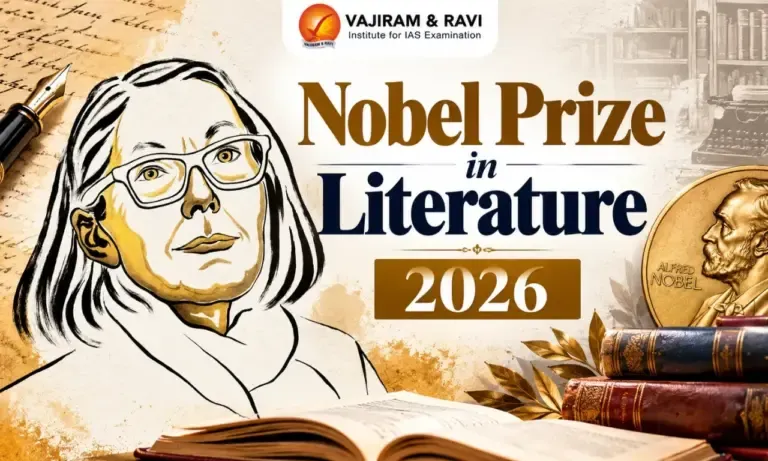
The 2026 Nobel Prize in Literature has been awarded to Canadian poet, essayist, classicist and translator Anne Carson. The Swedish Academy announced the winner on October 8, 2026, recognizing her bold and inventive body of work. Her writing brings classical traditions into conversation with modern ideas and creates new possibilities for contemporary literature.
Carson’s achievement highlights an important point: literature does not have to follow a fixed structure to move readers. Poetry, prose, translation and drama can work together to explore human emotions, memory, relationships and the meaning of life.
Her Nobel win also encourages readers to look beyond traditional definitions of literature. It shows how an original voice can transform familiar ideas into something fresh, challenging and deeply personal.
Why Anne Carson Won the 2026 Nobel Prize in Literature
Anne Carson has built a distinctive literary career by refusing to remain within the boundaries of a single genre. Her work combines poetry, prose, classical literature and experimental storytelling.
The Swedish Academy praised her for creating new forms for contemporary literature through a playful dialogue with the classical tradition. This recognition reflects the originality of her writing and her ability to connect ancient ideas with modern experiences.
Unlike writers who follow a conventional narrative from beginning to end, Carson often experiments with structure. She may combine different literary forms, explore an idea through fragments or use classical characters to examine questions that remain relevant today.
Her writing asks readers to think carefully rather than simply follow a plot. This approach can make her work demanding, but it also gives readers room to interpret ideas in their own way.
The 2026 Nobel Prize in Literature therefore celebrates more than individual books. It recognizes a literary vision that continues to expand what writing can achieve.
Anne Carson’s Unique Approach to Literature
One of the most interesting aspects of Carson’s work is her ability to connect different periods of human history. She draws on ancient Greek literature while exploring emotions and questions that modern readers can easily recognize.
Love, desire, loss, identity and the limits of language appear in many of her works. However, she rarely approaches these subjects in an ordinary way.
Instead, she combines different voices, forms and perspectives. A poem may contain elements of an essay, while a dramatic work may reinterpret a story from classical mythology.
This flexibility makes her writing difficult to place in one category. It also explains why her work has attracted attention from readers, critics and scholars across different literary fields.
Carson’s approach reminds us that literary innovation does not always require a completely new subject. Sometimes, it comes from looking at familiar experiences through an unexpected form.
Important Works That Define Anne Carson’s Career
Anne Carson has produced a wide range of books that demonstrate her interest in classical traditions and experimental writing. Several titles are especially useful for understanding her literary style.
1. Autobiography of Red
Published in 1998, Autobiography of Red is among Carson’s best-known works. Often described as a novel in verse, it reimagines the Greek myth of Geryon, a figure associated with the story of Herakles.
Rather than presenting the myth as a traditional retelling, Carson gives it a modern emotional dimension. The work explores identity, desire and personal experience through an unusual mixture of poetry and narrative.
Its distinctive structure shows how an ancient story can become a fresh literary experience without losing its connection to the past.
2. Eros the Bittersweet
In Eros the Bittersweet, Carson examines desire through the worlds of ancient Greek poetry and philosophy.
The book explores how longing can create both pleasure and pain. It also considers the relationship between desire, distance and the way people understand one another.
This work reflects Carson’s background in classical studies. It combines literary analysis with a broader examination of human relationships.
3. Nox
Nox is another important work in Carson’s career. It reflects on the death of her brother and explores grief, memory and the difficulty of expressing personal loss.
The book uses a distinctive visual and fragmentary format. Its structure reflects the way memories can appear incomplete, disconnected or difficult to explain.
Through this approach, Carson demonstrates that the physical form of a book can become part of its emotional meaning.
Why the 2026 Nobel Prize Matters for Modern Literature
The 2026 Nobel Prize in Literature arrives at a time when readers encounter stories through many different formats. Printed books remain important, but digital publishing, audiobooks, online essays and experimental storytelling have expanded how literary work reaches audiences.
Carson’s achievement is not simply a celebration of new technology or changing reading habits. Instead, it highlights the continuing value of artistic experimentation.
Literature has never been limited to one style. Some writers build complex fictional worlds, while others explore a single emotion through a short poem. Some use straightforward language, while others challenge readers with unusual structures and layered meanings.
What matters is whether the work offers a compelling artistic vision.
Carson’s Nobel recognition gives greater visibility to writing that crosses traditional boundaries. It may also encourage readers to explore works that do not fit neatly into familiar categories.
Literature Beyond Traditional Forms
For generations, many readers have associated literature with conventional novels, published poetry collections and plays. These forms remain valuable, but they represent only part of the literary landscape.
Writers have always experimented with structure, voice and language. Some combine autobiography with fiction. Others bring historical documents into creative narratives or use poetry to examine political and cultural questions.
Such experimentation can make literature more challenging, but it can also reveal experiences that conventional storytelling struggles to express.
Anne Carson’s work illustrates this possibility. Her writing does not treat form as a set of rules that must always be followed. Instead, the structure often becomes part of the story itself.
A fragmented narrative, for example, can reflect the uncertainty of memory. A combination of poetry and prose can capture an emotion that might lose its force in a conventional paragraph.
The lesson is not that traditional writing is outdated. It is that literature becomes richer when writers have the freedom to choose the form that best serves their ideas.
Human Emotion and the Value of Literary Creativity
Modern readers live in a world filled with fast-moving information, digital entertainment and increasingly sophisticated artificial intelligence tools. These developments have changed how people write, publish and consume content.
Yet literature continues to offer something beyond the simple delivery of information. It gives readers an opportunity to spend time with complex emotions, unfamiliar perspectives and difficult questions.
A powerful literary work does not always provide clear answers. Sometimes, it helps readers understand why a question is difficult in the first place.
Carson’s writing encourages this kind of engagement. Her use of classical references, unusual structures and personal themes invites readers to make connections rather than passively receive information.
Artificial intelligence can assist with research, translation and writing tasks. However, the value of a literary work depends on more than its structure or technical execution. Its meaning also comes from artistic choices, cultural context and the way readers interpret the finished work.
The 2026 Nobel Prize in Literature offers an opportunity to consider these qualities and the lasting role of creative writing in modern society.

What the Nobel Prize Means for Emerging Writers
For young writers, Carson’s recognition offers a useful reminder: originality does not always come from following established expectations.
Writers often feel pressure to choose a popular genre, imitate successful authors or follow familiar storytelling patterns. Learning the basics of writing is important, but creative development also requires experimentation.
Emerging writers can learn from Carson’s willingness to combine different forms and revisit classical ideas from new perspectives.
There are several practical lessons worth considering:
- Focus on the central idea: A strong piece of writing begins with something meaningful to explore.
- Choose the right form: A story, essay or poem should use a structure that supports its purpose.
- Read beyond familiar genres: Translated literature, experimental poetry and classical texts can introduce new ways of thinking.
- Revise with care: Unusual writing still benefits from clear choices, careful editing and attention to detail.
- Develop an individual voice: Studying other writers can help, but imitation alone rarely produces distinctive work.
These lessons apply to both experienced authors and people who are only beginning to write.
The Lasting Significance of Anne Carson’s Nobel Win
The Nobel Prize in Literature can bring international attention to a writer’s work, but its broader significance often lies in the questions it raises about literary value.
Anne Carson’s 2026 award invites readers to reconsider the relationship between tradition and innovation. Her work draws on ancient literature while finding new ways to discuss emotions, identity and human experience.
This combination is important because literature is never completely separate from the past. Writers inherit languages, stories and ideas from earlier generations. They can preserve those traditions, challenge them or transform them into something new.
Carson’s achievement shows how these possibilities can exist together.
Her Nobel win may also lead more readers to discover books that they might otherwise have overlooked. Some will appreciate her unusual structures, while others may find her work difficult. Both responses are part of the experience of encountering challenging literature.
The important point is that literature remains open to change. Its boundaries can expand without making its history less valuable.
Final Thoughts
The 2026 Nobel Prize in Literature recognizes Anne Carson for a body of work that challenges conventional literary categories and creates new possibilities for writing.
Her combination of poetry, prose, classical traditions and experimental forms demonstrates that literature can evolve without losing its connection to human experience.
For readers, her Nobel win offers a reason to explore unfamiliar books and reconsider what makes a work of literature meaningful. For writers, it provides an example of how curiosity, careful thought and creative experimentation can shape an individual literary voice.
Ultimately, literature does not need to follow one formula to remain relevant. Its strength lies in its ability to explore human experience from different perspectives and find new ways to express ideas that have mattered for generations.
Anne Carson’s recognition is a reminder that the future of literature does not depend on preserving every old boundary. It depends on the willingness of writers and readers to discover what lies beyond them.
Frequently Asked Questions (FAQs)
Who won the 2026 Nobel Prize in Literature?
Canadian poet, essayist, classicist and translator Anne Carson won the 2026 Nobel Prize in Literature. The Swedish Academy announced her as the laureate on October 8, 2026.
Why did Anne Carson win the Nobel Prize in Literature?
She was recognized for her bold and inventive body of work, which creates new forms for contemporary literature through an engagement with classical traditions.
What is Anne Carson’s most famous book?
Autobiography of Red is one of her best-known works. Published in 1998, it reimagines a Greek myth through a modern narrative in verse.
What makes Anne Carson’s writing different?
Her writing combines poetry, prose, classical literature and experimental structures. She often explores complex emotions and ideas through forms that cross conventional genre boundaries.
When is the 2026 Nobel Prize in Literature ceremony?
The Nobel Prize award ceremony is scheduled for December 10, 2026, in Stockholm, Sweden.
Where can readers learn more about the Nobel Prize in Literature?
Readers can visit the official Nobel Prize website for information about the award, its laureates and the announcement of each year’s winner.
Also Read This
- Mansory Bugatti Chiron Vivere: Inside the One-Off Hypercar Linked to a Mexican Collector
- US Lifts Sanctions on Russian Diesel: What It Means for Global Fuel Prices
- Amazon Great Indian Festival 2026: iPhone 16 and iPhone 17e Deals, Prices and Bank Offers
- Why Green and Sustainable Cars Are No Longer Just a Trend in India
- Intel Raptor Lake Refresh 2027: What the Latest Gigabyte Leak Reveals