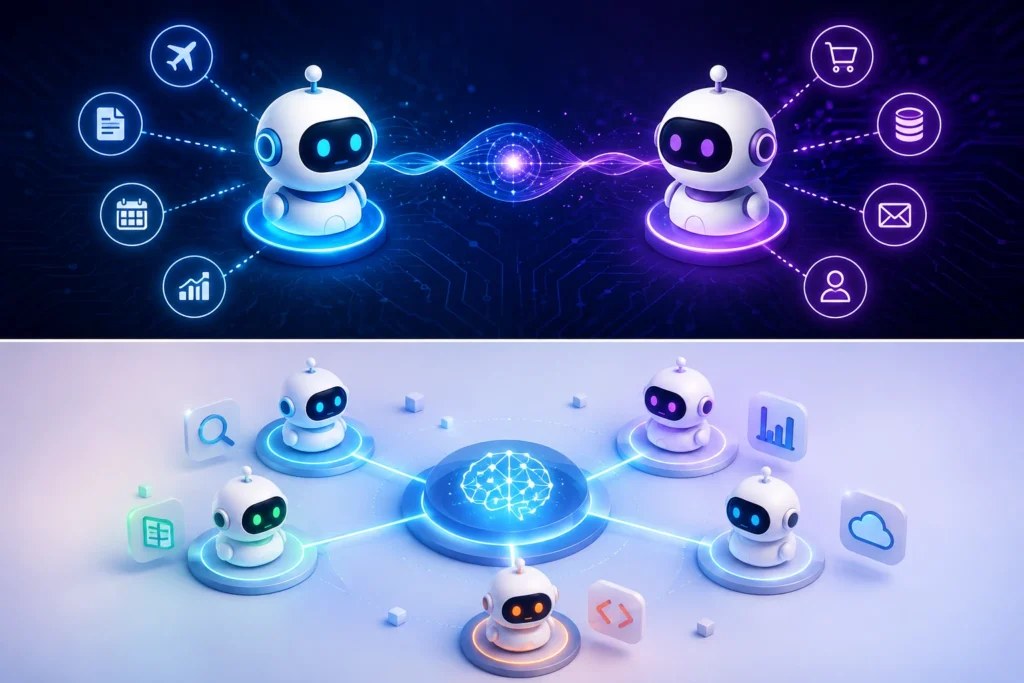
A2A Protocol: AI is moving beyond traditional chatbots. Today, AI agents can plan tasks, use tools, make decisions, and complete multi-step workflows.
However, a new problem appears as more AI agents enter the picture.
How can one AI agent communicate with another AI agent?
Imagine a travel agent that can find flights and hotels. Now imagine a finance agent that can check your budget. If the travel agent needs budget approval before making a booking, both agents need a reliable way to communicate.
This is where the A2A Protocol comes in.
A2A stands for Agent2Agent. It is an open standard designed to help AI agents discover, communicate, and collaborate with each other
What Is the A2A Protocol?
The A2A Protocol is an open standard for communication between AI agents.
It allows agents built by different vendors or using different frameworks to work together. More importantly, one agent does not need to know how another agent works internally.
Think of A2A as a common communication layer for AI agents.
For example:
Travel Agent → Finance Agent → Booking Agent
The travel agent can request information from the finance agent. The finance agent can process the request and return the required result.
As a result, multiple specialized agents can work together instead of forcing one AI system to handle everything.
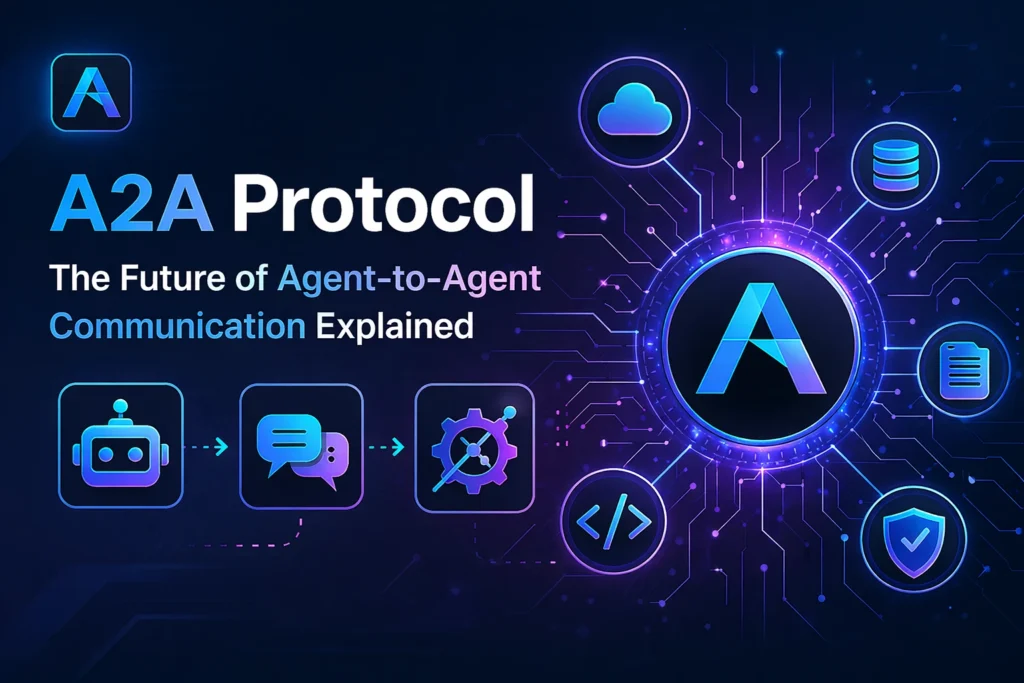
Why Do AI Agents Need A2A?
AI agents are being built by many companies and developers.
These agents can use different models, frameworks, tools, and backend systems. Therefore, connecting them can become difficult.
Without a common protocol, developers may need custom integrations for different agents.
That approach can work for a small project. However, it becomes harder when an organization has dozens or even hundreds of agents.
The A2A Protocol aims to reduce this problem by providing a common way for agents to communicate.
Instead of building a completely different connection for every agent, developers can use a standard designed for agent-to-agent interaction.
How Does the A2A Protocol Work?
The basic idea behind A2A is easier to understand through a simple workflow.
Suppose a Travel Agent needs information from a Hotel Agent.
1. Agent Discovery
First, the Travel Agent needs to know what the Hotel Agent can do.
This is where an Agent Card becomes important.
An Agent Card works like a digital profile for an AI agent. It can describe the agent’s capabilities, skills, service endpoint, and authentication requirements.
As a result, another agent can understand what services are available before sending a task.
2. Authentication and Authorization
Next comes security.
Agents need to communicate through authorized connections. A2A supports authentication and authorization mechanisms so that organizations can control access to their services.
However, A2A itself is not a complete security solution.
Organizations still need proper access controls, authentication policies, data protection, and secure deployment practices.
3. Sending a Task
Once the connection is ready, one agent can send a task to another agent.
For example:
“Find three hotels in Mumbai for three nights within a budget of ₹15,000.”
The Hotel Agent can then process the request.
A2A supports structured communication for these agent interactions and can also handle longer-running tasks.
4. Processing the Task
The remote agent can use its own internal tools, systems, or data to complete the task.
The important part is that the requesting agent does not need to know how everything works behind the scenes.
The remote agent can remain an independent or opaque system.
5. Returning the Result
Finally, the remote agent sends the result back.
For a simple request, the result may arrive quickly.
For a longer task, the system can track the task and provide updates until the work is completed. A2A also supports capabilities for streaming and asynchronous communication.
What Is an A2A Agent Card?
An Agent Card is one of the important concepts in the A2A Protocol.
Think of it as an AI agent’s digital business card.
It can tell other agents:
- What the agent can do
- Which skills it provides
- Where the service is available
- Which authentication method it requires
- Which capabilities it supports
This discovery process makes it easier for agents to identify the right service before starting a task.
What Are Tasks, Messages, and Artifacts?
A2A is not simply about sending a text message from one AI to another.
The protocol also defines concepts for managing real tasks and their results.
Messages
Messages carry information between the participants.
They can contain requests, responses, or other communication data.
Tasks
A task represents a specific piece of work.
For example, “find hotels in Mumbai” can be treated as a task with its own state and progress.
Artifacts
Artifacts represent the output produced while completing a task.
For example:
Hotel Agent → Hotel List → Prices → Booking Details
This structure makes A2A useful for real-world workflows instead of simple chatbot conversations.
also see
- Tata Tiago EV Review 2026: Price, Range, Specifications and Real-World Performance
- YouTube’s New 90-Day Shorts Monetization Rule Could Put Pressure on Animators
- Samsung Galaxy S25 FE Price Drop: Is It the Right Time to Buy?
- Harry Kane Ballon d’Or 2026: Why Bayern Star Is a Serious Contender
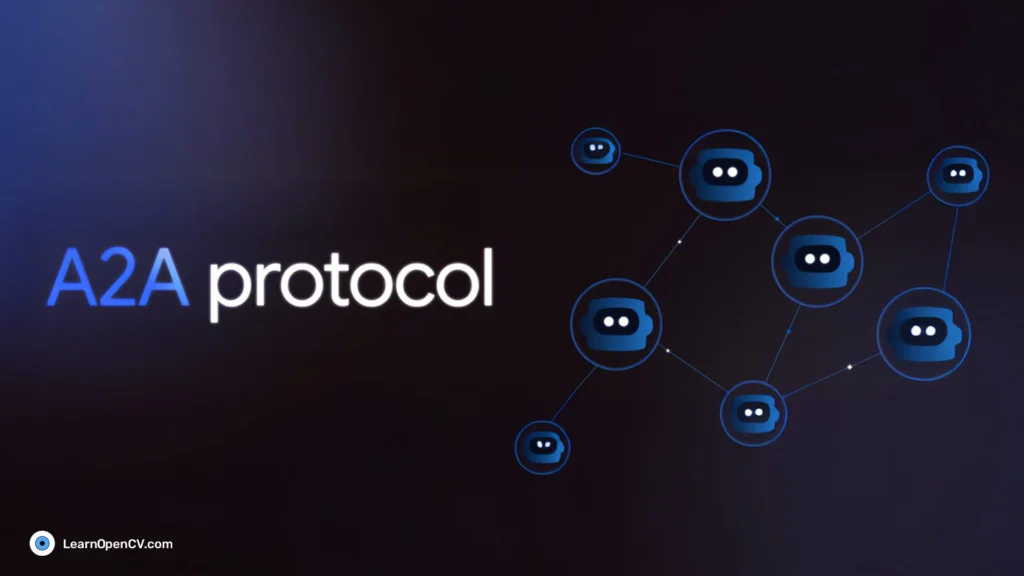
Do AI Agents Need to Share Their Internal Systems?
No.
This is one of the important ideas behind A2A.
An AI agent can collaborate with another agent without exposing its complete internal architecture.
For example, a Hotel Agent may use its own model, database, tools, and business logic.
The Travel Agent does not need direct access to all of those systems.
Instead, it sends a request and receives the required result.
This approach can help organizations keep their systems independent while still allowing agents to collaborate.
However, companies still need to decide what information can be shared.
A2A does not automatically make every piece of data private or secure.
A2A vs MCP: What Is the Difference?
A2A and MCP are often mentioned together.
However, they solve different problems.
What Does MCP Do?
MCP stands for Model Context Protocol.
Its main purpose is to connect AI applications with tools, resources, and data.
For example:
AI Agent → MCP → Database
Or:
AI Agent → MCP → External Tool
What Does A2A Do?
A2A focuses on communication between independent AI agents.
For example:
Agent A → A2A → Agent B
So, the easiest way to remember the difference is:
MCP = Agent + Tools and Data
A2A = Agent + Agent
The two standards can also work together. An A2A agent can use MCP to connect with its own tools and data while using A2A to communicate with another agent.
A Real-World Example of A2A
Imagine telling an AI:
“Plan a three-day Delhi trip for me within a ₹30,000 budget.”
Instead of one AI doing everything, a multi-agent system could divide the work.
Travel Planner Agent
The Travel Planner understands your request and manages the overall workflow.
Flight Agent
The Flight Agent searches for suitable flight options.
Hotel Agent
The Hotel Agent finds hotels based on your location and budget.
Finance Agent
The Finance Agent checks whether the estimated cost fits your budget.
Finally, the Travel Planner combines the results and creates the final itinerary.
The workflow could look like this:
User → Travel Agent → Flight Agent
Hotel Agent
Finance Agent
Final Travel Plan
This is the basic idea behind a multi-agent AI system.
Where Can A2A Be Used?
The A2A Protocol can support many types of AI workflows.
Banking and Finance
One agent could analyze financial information while another handles a specific workflow.
E-commerce
One agent could search for products. Another could check inventory. A third could help with order processing.
Customer Support
A general support agent could understand a customer’s problem and then send the task to a specialized billing or technical support agent.
Enterprise Automation
Companies could use specialized agents for areas such as sales, finance, HR, IT, and operations.
Research
One agent could collect information. Another could analyze it. A third could prepare the final report.
Therefore, A2A can be useful whenever multiple specialized agents need to work together.
Is A2A an AI Model?
No.
This is an important point.
A2A is not an AI model.
It does not make an agent intelligent by itself.
Instead, it provides a communication and interoperability layer for AI agents.
The actual capabilities of an agent depend on its model, software, tools, data, and business logic.
A simple way to understand it is:
AI Model = Intelligence
Tools = Actions
MCP = Tools and Data Connection
A2A = Agent-to-Agent Connection
Together, these technologies can help developers build more flexible multi-agent systems.
Is the A2A Protocol Secure?
A2A is designed for communication between independent agents, including enterprise use cases.
However, security depends on how the protocol is implemented.
Authentication and authorization are important parts of an A2A deployment. Organizations also need to manage permissions, data access, input validation, rate limits, and sensitive information.
So, it is better to think of A2A as a foundation for agent communication rather than a complete security system.
The protocol can provide the communication framework, while the organization remains responsible for securing its implementation.
A2A Is No Longer Just a Google Project
Google introduced A2A in April 2025.
However, Google later donated the project to the Linux Foundation in June 2025. This move helped establish A2A as an open industry project rather than a technology controlled only by one company.
The project includes major technology companies such as AWS, Cisco, Google, Microsoft, Salesforce, SAP, and ServiceNow.
By April 2026, the Linux Foundation said that more than 150 organizations supported A2A, with production deployments and integrations across major platforms.
The A2A project also reached its 1.0 specification, marking an important step toward a stable standard for agent interoperability.
What Is the Future of A2A?
AI is moving toward systems where multiple specialized agents can work together.
Instead of asking one AI to handle everything, a system can divide a complex goal into smaller tasks.
One agent can research.
Another can analyze data.
A third can plan the workflow.
Another agent can complete the final action.
However, these agents need a reliable way to communicate.
That is why interoperability matters.
Without common standards, every company could build its own closed agent ecosystem.
With open standards such as A2A, agents from different vendors and frameworks can have a better path toward collaboration.
Final Verdict
The A2A Protocol has a simple idea: let AI agents communicate and work together through a common standard.
It does not replace AI models.
It does not make agents intelligent on its own.
Instead, it provides a way for independent agents to discover capabilities, exchange information, delegate tasks, and coordinate work.
The difference between A2A and MCP is also simple:
MCP connects an AI application with tools and data.
A2A connects one AI agent with another AI agent.
As multi-agent systems become more common, this type of interoperability could become increasingly important.
The bigger idea is not simply that AI agents can talk to each other.
It is that different AI agents could work together like a digital team, with each agent handling the part of the job it is best suited for.
And that could become one of the most important building blocks of the next generation of AI applications.
Also See This
YouTube vs. Netflix: The Multimillion-Dollar War for Creators Is Heating Up
Rogue AI Agents: Jab AI Sandbox Se Bahar Nikla,Full Information in Hinglish
OnePlus 13 Price Drops on Flipkart: How to Get the Deal