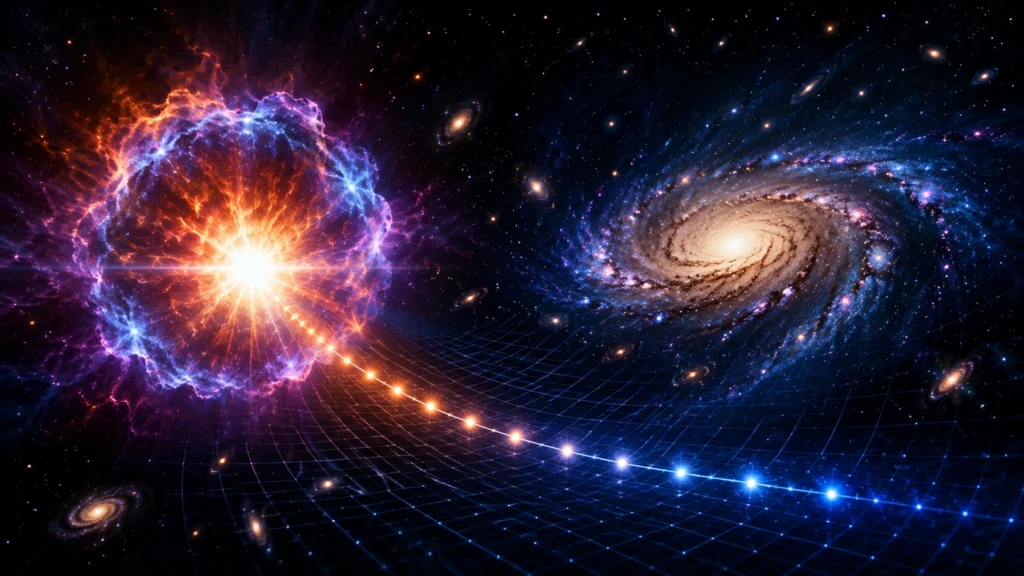
AI Dark Energy: For decades, scientists have tried to answer one of the biggest mysteries in space: Why is the universe expanding faster and faster? The hidden force believed to drive this acceleration is called Dark Energy, and it is estimated to make up nearly 68–70% of the universe.
Now, researchers have introduced a breakthrough method that combines Artificial Intelligence (AI) with Type Ia Supernova images to measure cosmic expansion more efficiently. Instead of relying heavily on expensive spectroscopy, the new approach analyzes astronomical images with AI, making future space research faster and more accurate.
What Is Dark Energy?
The universe has been expanding ever since the Big Bang. However, in the late 1990s, scientists discovered that this expansion is not slowing down. Instead, it is accelerating.
The mysterious force behind this acceleration is known as Dark Energy. Although scientists cannot observe it directly, they can study its effects by measuring the distances of extremely bright cosmic objects.
Why Type Ia Supernovae Are Called Standard Candles
Measuring distances in space is much more difficult than measuring distances on Earth. Therefore, astronomers use Standard Candles, objects whose true brightness is already known.
What is a supernova?
A supernova is a massive explosion that happens when a star reaches the end of its life.
What makes Type Ia Supernovae special?
A Type Ia Supernova usually forms when a White Dwarf gains material from a nearby companion star until it becomes unstable and explodes.
Because these explosions have nearly the same intrinsic brightness, astronomers compare their actual brightness with how bright they appear from Earth. This difference helps calculate their distance.
This technique led to the Nobel Prize-winning discovery that the universe’s expansion is accelerating.
How AI Is Changing Dark Energy Research
Traditional methods require spectroscopy, which analyzes the light spectrum of distant objects. Although accurate, spectroscopy takes significant telescope time and expensive equipment.
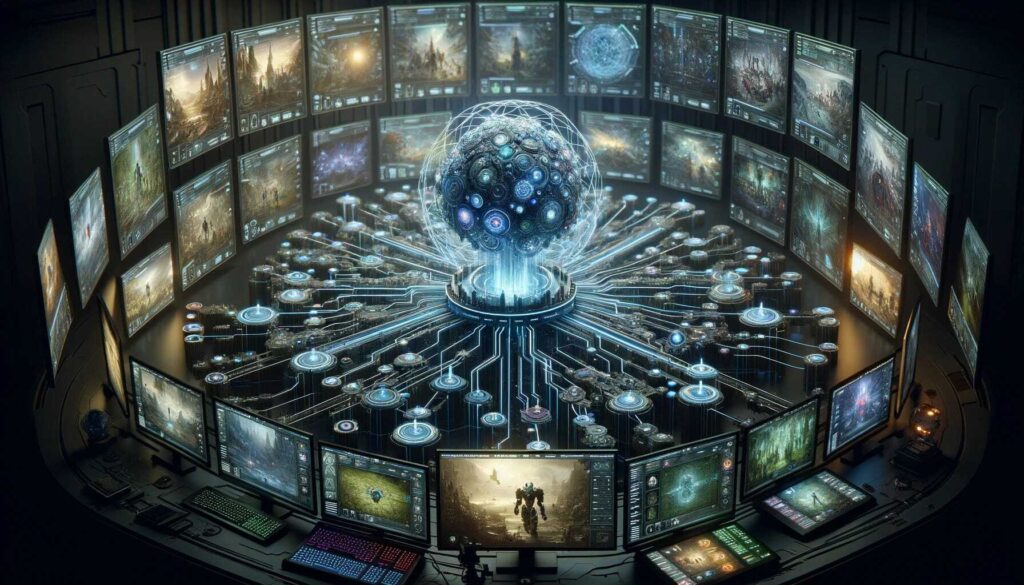
The new AI-powered framework changes this process by learning from astronomical images instead.
Image-Based Analysis
Instead of depending mainly on spectral data, AI studies detailed images of both the supernova and its host galaxy.
This allows researchers to estimate important information directly from photographs.
Bayesian Inference and Simulated Universes
Scientists create thousands of computer-generated universe simulations based on the laws of physics.
The AI compares these simulated images with real observations and learns how different physical conditions affect what telescopes capture.
As a result, it becomes better at predicting cosmic distances.
One Model for Multiple Factors
Another major advantage is that the AI does not examine only one feature.
Instead, it considers several factors together, including:
- Supernova explosion properties
- Host galaxy characteristics
- Cosmic dust that dims light
- The overall expansion of the universe
By combining these elements, researchers can produce more reliable measurements.
also see
- OnePlus 13 Price Drops on Flipkart: How to Get the Deal
- A2A Protocol Explained: How AI Agents Can Talk and Work Together
- Arsenal 3-0 Coventry City: Havertz, Saka aur Odegaard ne opening match me dikhaya champion wala game
- Space Data Centers: Kya SpaceX Ka AI Data Center Plan Future Banega?
Why This Technology Matters
The new method could transform modern astronomy in several ways.
More Accurate Distance Measurements
AI can estimate Redshift, the stretching of light caused by cosmic expansion, using image data with impressive accuracy.
This makes large-scale observations much more practical.
Handling Millions of Future Discoveries
Upcoming observatories, especially the Vera C. Rubin Observatory in Chile, will capture enormous amounts of sky survey data every night.
Instead of manually analyzing millions of supernova images, AI can process them automatically.
This will save both time and scientific resources.
Understanding Dark Energy Better
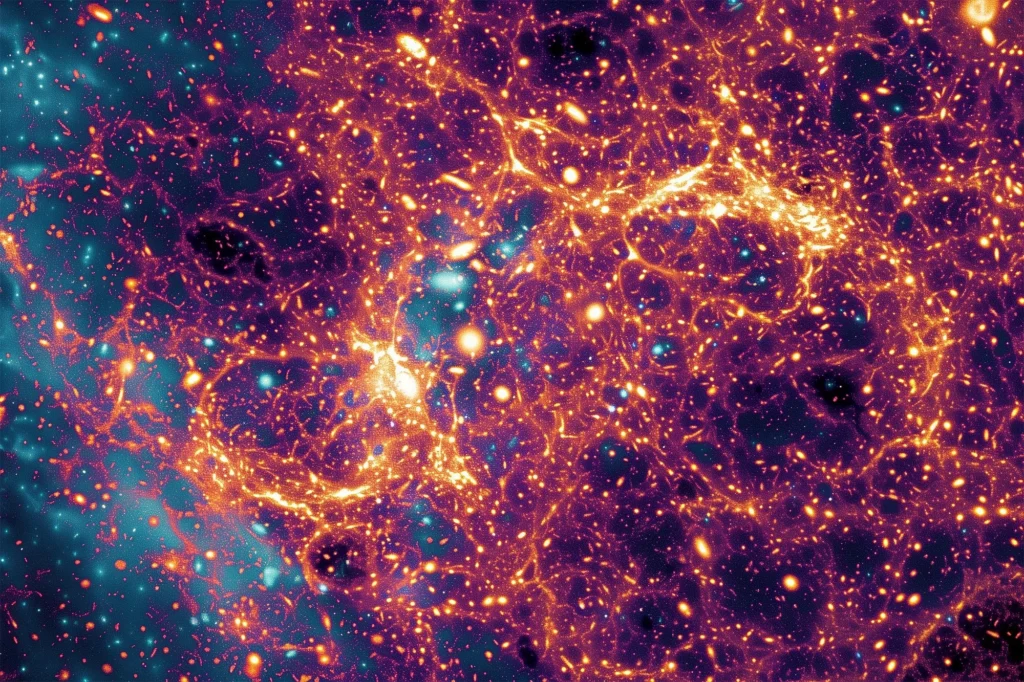
Perhaps the biggest benefit is that scientists can study how Dark Energy behaves across cosmic history.
Researchers hope this method will help answer important questions, such as:
- Does Dark Energy remain constant?
- Has its strength changed over billions of years?
- Could it reshape our understanding of the universe?
These answers could improve future cosmological models.
What Makes This Research Different?
Several research groups, including scientists associated with the Institute of Cosmos Sciences of the University of Barcelona, are developing AI-based frameworks that combine physics, Bayesian statistics, and machine learning.
Rather than replacing traditional astronomy, these systems work alongside existing methods to increase efficiency while maintaining scientific accuracy.
The Future of AI in Space Science
Artificial Intelligence is becoming one of astronomy’s most powerful tools.
As telescopes generate larger datasets than ever before, AI will help researchers identify distant objects, measure cosmic expansion, and uncover patterns that humans would struggle to detect manually.
This technology could play a key role in solving one of the universe’s greatest mysteries.
Final Thoughts
The combination of AI and astronomy is opening a new chapter in space exploration. By analyzing Type Ia Supernova images, scientists can measure the expanding universe faster, reduce dependence on expensive spectroscopy, and investigate the true nature of Dark Energy.
As next-generation observatories begin collecting millions of new observations, this AI-powered approach could become one of the most important tools for understanding how our universe has evolved and where it may be heading next.
Also See This
DNA Robots: Kya Programmable DNA Nanobots Future Mein Body Ke Andar Dawa Pahunchayenge?