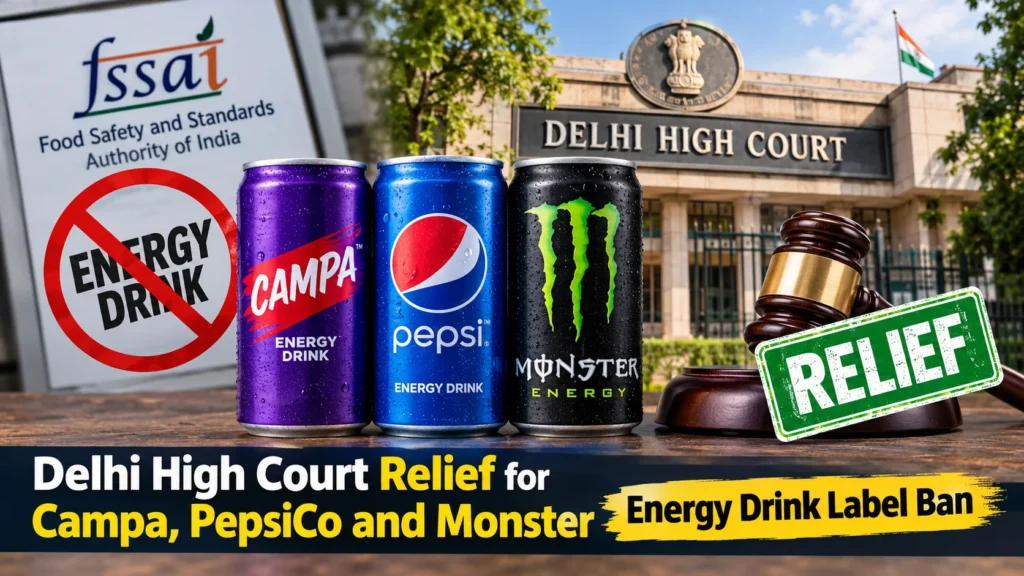
Energy Drink Label Ban: India’s beverage industry has received an important legal update after the Delhi High Court granted interim relief to Reliance Consumer Products, PepsiCo and Monster Beverage in their dispute with the Food Safety and Standards Authority of India (FSSAI) over the use of the term “Energy Drink.”
The energy drink label ban has become a major issue for beverage companies because the FSSAI had directed several brands to stop using the “Energy Drink” descriptor on certain high-caffeine beverages.
The latest court orders provide temporary relief to the companies. However, the dispute is not over yet. The High Court has not given a final decision on whether FSSAI can permanently restrict the label.
What Is the Energy Drink Label Dispute About?
The controversy started after FSSAI took action against beverage companies using the term “Energy Drink” for certain products.
The regulator raised concerns about product labelling, classification and claims that could potentially mislead consumers.
In June 2026, FSSAI directed several companies to stop using the “Energy Drink” description on their products. The brands affected included PepsiCo’s Sting and Adrenaline Rush, Monster Energy, Reliance Consumer Products’ Campa Energy Drink and other products.
FSSAI also raised concerns about claims associated with products that suggest they can improve energy, focus or other aspects of performance without adequate regulatory support.
The companies challenged the regulatory action before the Delhi High Court.
Delhi High Court Gives Interim Relief
On October 6, 2026, the Delhi High Court considered the petitions filed by the beverage companies.
Justice Amit Mahajan passed interim orders providing relief to Reliance Consumer Products, PepsiCo and Monster Beverage.
The court also questioned the way some of the FSSAI directions were issued, particularly the absence of a show-cause notice and an opportunity for the companies to respond before regulatory action was taken.
This point became important because the companies argued that they should have been given a chance to explain their position before the directions were enforced.
The court’s intervention does not mean that FSSAI has lost its regulatory authority. Instead, the immediate enforcement of the disputed directions has been put on hold in the cases before the court.
What Happened to Campa Energy Drink?
Reliance Consumer Products, which markets Campa, received separate interim protection from the Delhi High Court.
The FSSAI had directed Reliance Consumer Products to remove the “Energy Drink” descriptor from Campa Energy Drink – Gold Boost.
The company challenged the direction and argued that the action had caused serious business disruption.
The Delhi High Court stayed the June 30 FSSAI order against Reliance Consumer Products. The court also stayed the related communication issued to state and Union Territory food safety authorities for enforcement.
For Campa, this is an important development because the company can continue its marketing position while the legal proceedings continue.
However, this is an interim order. It should not be treated as a final victory in the wider regulatory dispute.
PepsiCo and Monster Get Relief on Existing Stock
The position for PepsiCo and Monster has an important difference.
The Delhi High Court allowed the companies to sell their existing stocks carrying the “Energy Drink” label.
However, the court did not give them a blanket permission to manufacture fresh products using the same descriptor.
In other words, the interim protection helps companies deal with products that were already manufactured and labelled before the court’s order.
The court made it clear that the relief does not automatically allow new production carrying the disputed “Energy Drink” description.
This distinction is important because reports describing the order simply as a complete reversal of the FSSAI action can give consumers the wrong impression.
The legal dispute is still active.
Why Did FSSAI Object to the Term “Energy Drink”?
FSSAI’s action is linked to concerns around the marketing and labelling of high-caffeine beverages.
Caffeine is a stimulant, and many energy drinks also contain ingredients such as taurine and significant amounts of sugar.
The regulator has been examining whether the term “Energy Drink” could create a misleading impression about what these beverages actually provide.
FSSAI has also raised concerns about marketing claims such as improving focus, increasing energy levels or helping with weakness when such claims may not meet the applicable regulatory requirements.
This does not mean that every beverage containing caffeine is unsafe.
Instead, the dispute is focused on how such products are classified, labelled and marketed to consumers.
Why the Court’s Interim Relief Matters
The court’s decision is significant for the beverage industry because packaging changes can be expensive and time-consuming.
Large beverage companies produce millions of cans and bottles for the Indian market.
If a company suddenly has to remove a product description from its packaging, it may have to deal with existing inventory, printed packaging material, distribution issues and retailer concerns.
Reliance Consumer Products, for example, told the court that it had a large amount of inventory and pre-printed packaging carrying the “Energy Drink” label.
The interim relief therefore gives the affected companies some breathing room while the legal dispute continues.
What Does This Mean for Consumers?
For consumers, the immediate impact is relatively simple.
Some products carrying the “Energy Drink” description can continue to remain in the market under the protection granted by the court.
Consumers should still check the product label for information about caffeine, sugar and other ingredients.
The court’s interim orders do not change the nutritional composition of the beverages.
They mainly deal with the regulatory dispute surrounding the product description and FSSAI’s enforcement action.
This case also highlights why clear food and beverage labelling matters.
Consumers often use product names and descriptions to understand what they are buying. Clear information can help people make better choices, especially when products contain stimulants such as caffeine.
What Does This Mean for Campa, PepsiCo and Monster?
For Campa, the court’s order provides important temporary protection while Reliance Consumer Products continues its challenge against the FSSAI direction.
For PepsiCo, the order provides protection for existing products carrying the “Energy Drink” label, including products such as Sting and Adrenaline Rush.
Monster Beverage also received relief concerning its existing labelled stock.
The companies can therefore avoid an immediate disruption to their existing inventory, although the restrictions around fresh manufacturing remain important.
The court will examine the wider legal questions at later hearings.
A Bigger Question for India’s Beverage Industry
The dispute could have implications beyond these three companies.
India’s beverage market has expanded rapidly, with consumers showing strong interest in energy drinks, sports beverages and other functional drinks.
That growth has also increased regulatory attention.
Companies want clear rules that allow them to plan manufacturing, packaging and marketing.
At the same time, regulators have a responsibility to ensure that product descriptions do not mislead consumers.
The challenge is finding a balance between business interests and consumer protection.
The Delhi High Court’s proceedings could eventually provide more clarity on how these products should be labelled and what authority FSSAI has when enforcing such directions.
What Happens Next?
The legal battle is not finished.
The Delhi High Court has provided interim relief, but it has not delivered a final ruling on the entire dispute.
The next hearings will be important because the court may examine the arguments of both the beverage companies and FSSAI in greater detail.
The PepsiCo and Monster matters have been listed for further hearing on November 5, 2026.
Until then, the current interim directions remain important for the affected companies and their existing products.
The final outcome could influence how energy drinks and similar high-caffeine beverages are labelled and marketed in India.
Energy Drink Label Ban Final Takeaway
The Delhi High Court’s latest intervention has given Campa, PepsiCo and Monster some much-needed relief in the ongoing energy drink label ban dispute.
Reliance Consumer Products received a stay against the FSSAI direction concerning Campa Energy Drink – Gold Boost.
PepsiCo and Monster can sell their existing stocks carrying the “Energy Drink” label, although the court has not allowed unrestricted fresh production using the disputed descriptor.
The order is temporary, so it would be too early to call this a final victory for the beverage companies.
The bigger issue is still open: how should high-caffeine beverages be classified and labelled, and what process should FSSAI follow when taking enforcement action?
As the case moves forward, the decision could become an important reference point for India’s growing beverage industry.
For consumers, the key lesson is equally important. Regardless of what appears on the front of a bottle or can, checking the ingredient list, caffeine content and nutritional information remains the best way to understand what a beverage contains.
Also Read This
- 10 New Cars Expected to Launch in October 2026 in India: SUVs, EVs and Sedans
- 2027 Mercedes GLE: Jab S-Class Ki Luxury Aur SUV Ka Power Mila Ek Jagah
- Maruti Suzuki Arena Cars Get Up to Rs 1.36 Lakh Benefits in October 2026
- OPPO F35 Pro vs Vivo V70 FE vs OnePlus Nord 6: Which Phone Is Best?
- Xiaomi 18 Pro vs iPhone 18 Pro Speed Test: Which Phone Wins?