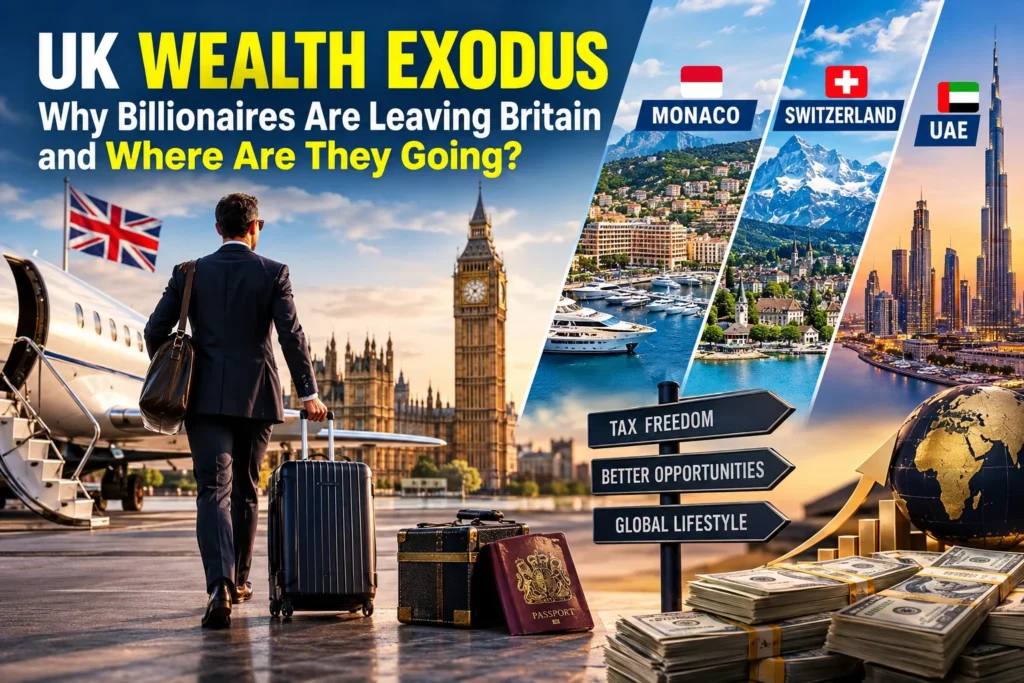
UK wealth exodus: Britain has long been one of the world’s biggest financial and wealth-management centres. London, in particular, has attracted billionaires, entrepreneurs, investors and wealthy families from around the globe.
But that picture is changing.
In recent years, more wealthy residents have started moving away from the United Kingdom or reducing their financial ties with the country. The reasons include changes to tax rules, uncertainty over future policies, inheritance tax concerns and the growing attraction of lower-tax destinations.
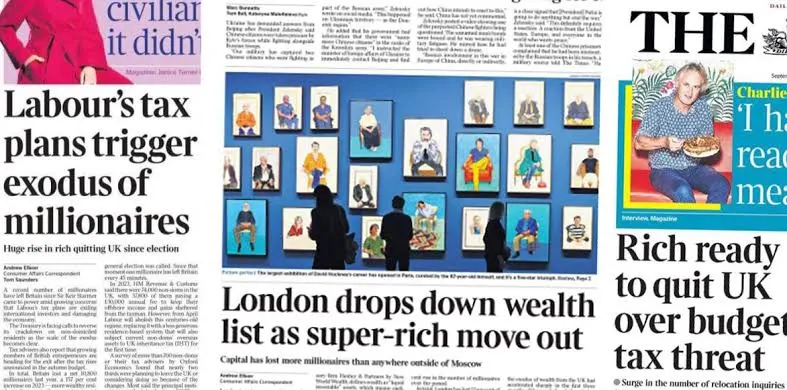
The scale of the shift has now become difficult to ignore. Henley & Partners estimated that around 16,500 millionaires left the UK in 2025, taking an estimated $91.8 billion in wealth with them.
Recent reporting has also highlighted a much larger shift among Britain’s billionaire class. Bloomberg data cited by The Guardian suggests that more than £121 billion of UK billionaire wealth has either left the country or weakened its ties with the UK since 2024.
So, why are wealthy people leaving Britain? And where are they going?
Let’s break it down.
UK Government: Non-Dom Tax Reform
Why Are Wealthy People Leaving the UK?
There is no single reason behind Britain’s wealth migration. Tax changes are important, but wealthy individuals also consider business conditions, political stability, investment opportunities and the overall cost of living.
Here are some of the biggest factors.
1. The End of the Non-Dom Tax System
One of the biggest changes came from the reform of the UK’s non-domiciled tax rules.
For many years, the non-dom system gave certain UK residents with permanent connections outside Britain access to special tax treatment on foreign income and gains.
The system changed from 6 April 2025. The UK replaced the old domicile-based approach with a residence-based system. A new four-year foreign income and gains regime was introduced for qualifying new arrivals who had not been UK tax resident during the previous 10 years.
The change matters because some wealthy international residents previously used the remittance basis to manage how their foreign income and gains were taxed in the UK.
For people with very large overseas investments, even a small change in tax treatment can have a major financial impact.
2. Inheritance Tax Has Become a Bigger Concern
Inheritance tax is another important part of the discussion.
From April 2025, the UK moved from a domicile-based system to a residence-based system for inheritance tax. Under the new rules, a person can become a long-term UK resident for inheritance tax purposes after being UK resident for at least 10 of the previous 20 tax years.
This means wealthy individuals cannot simply assume that moving assets overseas will automatically keep them outside the UK inheritance tax system.
For families with large international estates, the long-term tax consequences can therefore influence decisions about where they live and where they structure their wealth.
3. Concerns About Future Tax Policies
Another issue is uncertainty about what could happen next.
Britain continues to debate how much tax wealthy individuals and large estates should pay. Discussions around wealth taxes, property taxes, capital gains and inheritance tax create additional uncertainty for high-net-worth individuals.
It is important to separate confirmed policy from political speculation.
A proposed tax is not the same as an implemented tax. However, wealthy individuals often make decisions years ahead, especially when they are managing large businesses, investment portfolios and family estates.
That is why the expectation of future policy changes can sometimes influence migration before a new tax actually arrives.
4. Brexit and Britain’s Changing Economic Position
Brexit is also part of the wider picture.
The UK’s departure from the European Union changed Britain’s relationship with the European market. Businesses and investors have had to adapt to new trade arrangements, regulations and labour rules.
Brexit alone does not explain the movement of wealthy individuals. However, it is one factor that forms part of the broader debate about Britain’s competitiveness.
For global investors, the question is simple: can the UK continue to offer the same combination of financial opportunities, international access and lifestyle advantages that made London so attractive?
Where Are Wealthy Britons Moving?
When wealthy individuals leave a country, they usually look for more than a low tax rate.
They also consider political stability, infrastructure, financial services, schools, healthcare, privacy, travel connections and the ability to manage businesses internationally.
Several destinations have become particularly attractive.

Monaco: A Major European Wealth Hub
Monaco has long been associated with wealthy residents.
Its location on the French Riviera, political stability and tax environment make it attractive to high-net-worth individuals.
The tiny principality has also become home to a significant number of wealthy people from Britain’s Rich List.
Recent reporting says Monaco now houses at least 24 members of the 2026 Sunday Times Rich List, while more than £77 billion of British wealth is reportedly held by Monaco residents.
For some wealthy families, Monaco offers an appealing combination of lifestyle, security and tax advantages.
Switzerland: Stability and Wealth Management
Switzerland remains one of the world’s most important wealth-management centres.
The country is known for political stability, strong financial institutions and a highly developed private banking and asset-management industry.
For wealthy investors, Switzerland can offer something that goes beyond taxes: a mature financial ecosystem for managing complex international assets.
That makes it attractive to entrepreneurs, investors and family offices looking for a long-term base.
UAE: Dubai’s Growing Appeal
The United Arab Emirates has become another major destination for global wealth.
Dubai, in particular, has attracted entrepreneurs, investors and wealthy professionals from Europe, Asia and other parts of the world.
The UAE offers no federal personal income tax on individuals, along with modern infrastructure, international connectivity and a business-friendly environment.
Dubai also provides easy access to global markets and has built a strong ecosystem around finance, real estate, technology and international business.
As a result, it has become one of the world’s most visible destinations for mobile wealth.
Is Britain Really Losing $160 Billion?
This is where the numbers need some context.
The often-repeated $160 billion figure should not be presented as a confirmed amount of cash that has physically left Britain.
Different reports measure wealth migration in different ways. Some track the estimated wealth of people who relocate. Others look at billionaire wealth, investments or changes in residency.
For example, Henley & Partners estimated that the UK would lose around 16,500 millionaires in 2025, representing approximately $91.8 billion in estimated wealth.
More recent reporting using Bloomberg data puts the value of billionaire wealth that has either left the UK or weakened its ties with the country since 2024 at more than £121 billion.
These figures should not be added together because they measure different groups and concepts.
The bigger message is clear, though: wealth migration from Britain has become a serious economic and political issue.
What Happens When Wealthy People Leave?
The impact is more complicated than simply saying, “Billionaires are leaving, so Britain loses money.”
A wealthy resident can contribute to the economy in several ways.
They may pay income tax, capital gains tax, inheritance tax and property-related taxes. They may also spend money on homes, restaurants, private education, professional services and luxury goods.
Their businesses can employ thousands of people.
Their investment decisions can also affect financial markets and companies.
So, when wealthy individuals relocate, Britain can potentially lose some tax revenue and economic activity.
However, the opposite argument also matters.
A government may believe that changing tax rules creates a fairer system and generates additional revenue from people who remain in the country.
The real question is therefore not simply whether taxes should be higher or lower.
The bigger question is how much additional revenue a tax policy generates compared with the economic activity and investment it might discourage.
Could London’s Luxury Property Market Feel the Impact?
London’s luxury property market is another area worth watching.
Ultra-wealthy international buyers have historically played an important role in the high-end property market.
If fewer wealthy foreign buyers want to live in London, demand for expensive homes can weaken.
That does not mean London’s entire property market will collapse.
The housing market depends on many factors, including interest rates, supply, employment, mortgage costs and economic growth.
Still, a reduction in international demand could put pressure on the most expensive segment of the market.

What About Jobs and the Service Economy?
The wealthiest residents also support a large network of professional services.
Think about private bankers, accountants, lawyers, investment advisers, property managers, chefs, drivers, security professionals and luxury retailers.
When a billionaire moves permanently to another country, some of this spending can move with them.
That can affect businesses that depend heavily on high-net-worth clients.
At the same time, it would be wrong to claim that every wealthy person leaving Britain directly causes large-scale job losses.
The economic impact depends on how many people leave, how much they spend, whether their businesses remain in Britain and where their investments are located.
Britain Still Has Major Advantages
Despite the wealth exodus debate, the UK remains a major global financial centre.
London continues to have deep capital markets, leading universities, international businesses, professional services and a strong legal system.
The country also remains attractive to many entrepreneurs and investors.
Not every wealthy person is leaving.
Some high-profile billionaires have chosen to remain in Britain, while other wealthy individuals continue to establish businesses or maintain major investments there.
This is why describing the situation as a complete “billionaire escape” would be too simplistic.
The reality is more nuanced.
The Bigger Global Wealth Race
The UK’s situation reflects a much bigger global trend.
Wealth is becoming increasingly mobile.
A billionaire can own a company in one country, invest through another, live in a third and hold assets across several continents.
That makes tax policy and economic competitiveness increasingly important.
Countries are now competing not only for factories and technology companies, but also for entrepreneurs, investors and wealthy families.
Monaco offers lifestyle and tax advantages.
Switzerland offers financial stability and wealth management.
The UAE offers low personal taxation and a business-friendly environment.
The United States offers a huge capital market and access to one of the world’s largest economies.
For Britain, the challenge is to remain attractive while also maintaining a tax system that the government considers fair.
What Does This Mean for the Average Person?
At first glance, billionaire migration may seem like a problem that has nothing to do with ordinary people.
But the effects can spread through the wider economy.
Government revenue supports public services. High-end spending supports businesses. Investment can create jobs. Property transactions generate tax revenue.
At the same time, ordinary taxpayers also care about fairness.
Many people believe that wealthy individuals should contribute more because they have greater financial capacity.
This creates a difficult balancing act for governments.
Raise taxes too aggressively, and some wealthy people may relocate.
Keep taxes too low, and the government may struggle to raise enough revenue for public services.
Finding the right balance is the real challenge.
UK wealth exodus Final Takeaway
Britain’s wealth migration story is not simply about billionaires packing their bags and taking billions of pounds in cash overseas.
It is a much more complicated story involving tax reforms, inheritance rules, economic uncertainty, Brexit, lifestyle choices and growing competition from other global wealth centres.
The end of the UK’s old non-dom system in 2025 was a major change, and the number of wealthy people leaving Britain has increased according to private wealth-migration estimates.
But Britain still has enormous financial strengths, and not every wealthy individual is leaving.
The real issue for the UK is whether it can create a tax system that raises enough revenue while keeping the country attractive to entrepreneurs, investors and international businesses.
In today’s global economy, money and talent can move quickly.
That means countries are competing harder than ever to become the place where the world’s wealthiest people choose to live, invest and build their businesses.
What do you think? Should governments increase taxes on the ultra-rich, or should they focus on keeping wealthy investors and entrepreneurs in the country? Share your opinion in the comments.
Fact Check Note: Wealth-migration figures are estimates and different reports use different definitions of wealth, residency and capital movement. The figures in this article should therefore not be interpreted as a literal transfer of the same amount of cash out of the UK.
Also Read This
- 2027 Mercedes GLE: Jab S-Class Ki Luxury Aur SUV Ka Power Mila Ek Jagah
- Maruti Suzuki Arena Cars Get Up to Rs 1.36 Lakh Benefits in October 2026
- OPPO F35 Pro vs Vivo V70 FE vs OnePlus Nord 6: Which Phone Is Best?
- Xiaomi 18 Pro vs iPhone 18 Pro Speed Test: Which Phone Wins?
- Delhi High Court Relief for Campa, PepsiCo and Monster Over Energy Drink Label Ban