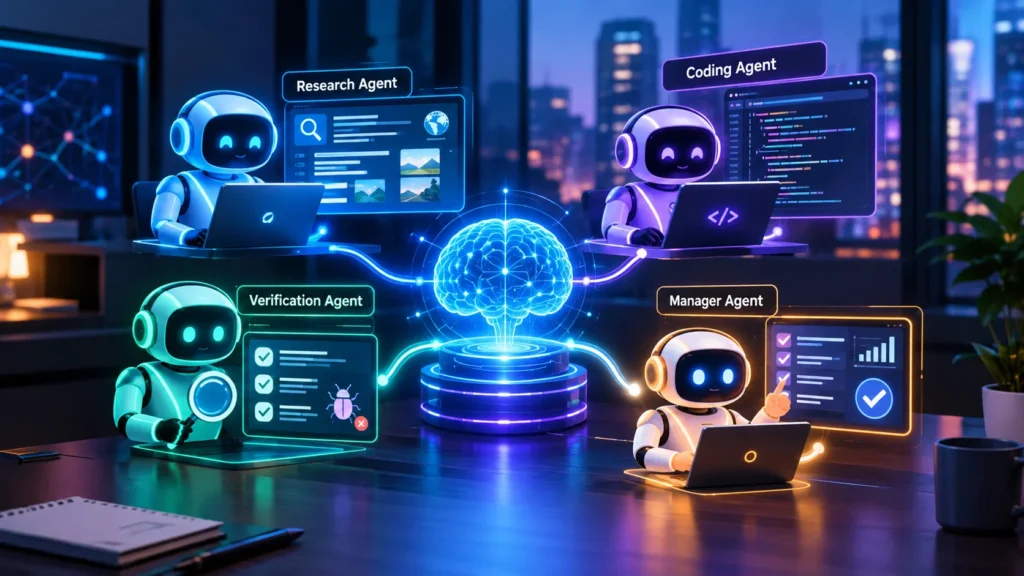
Multi-Agent AI System: Imagine asking one AI to build an app, write the code, test it, research the topic, and fix every mistake. It can do many of those tasks. However, what happens when a whole team of AI agents shares the work instead of one model doing everything?
That is exactly what a Multi-Agent AI System does.
Instead of relying on a single AI, this approach creates a team of specialized AI agents. Each agent has a specific role. One researches information, another writes code, another checks for errors, and another makes the final decision. As a result, complex tasks become faster, more organized, and often more reliable.
Many technology companies are now exploring this approach because it represents one of the biggest changes in modern artificial intelligence.
What Is a Multi-Agent AI System?
A Multi-Agent AI System is an AI architecture where multiple intelligent agents work together to complete a task. Rather than acting as one all-purpose assistant, each AI focuses on a particular responsibility.
Think of it like a software company.
If one person handles design, coding, testing, and planning alone, the project may take longer and mistakes become more likely. However, when experts divide the work, the entire process becomes smoother.
The same idea applies to AI.
Common AI Agent Roles
- Research Agent: Collects information from available sources.
- Coding Agent: Writes code or creates content.
- Verification Agent: Reviews work and finds mistakes.
- Manager Agent: Coordinates the team and approves the final result.
Because every agent specializes in one task, the workflow becomes more efficient.
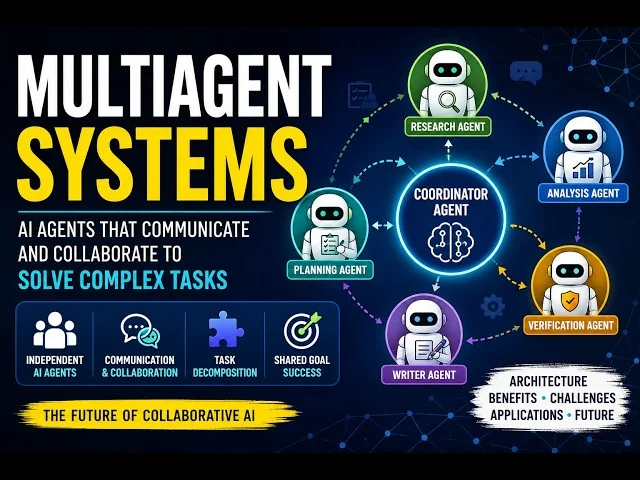
How Does a Multi-Agent AI System Work?
The process usually happens in several clear steps.
Step 1: Task Breakdown
The system first analyzes the user’s request.
Instead of treating it as one large problem, it divides the work into smaller tasks. This makes complex projects easier to manage.
Step 2: Agent Collaboration
Next, different AI agents communicate with each other.
For example, the Research Agent shares information with the Coding Agent. After that, the Verification Agent reviews the output and sends feedback if needed.
This continuous communication helps improve the final result.
Step 3: Self-Correction
One of the biggest advantages is automatic error correction.
If the Testing Agent discovers a problem, it sends the task back for improvement. The system can repeat this process until the output becomes better.
Therefore, human intervention becomes less necessary during many workflows.
Step 4: Final Approval
Finally, the Manager Agent reviews everything.
Once every important task is completed, the system delivers the final output to the user.
Why Is Multi-Agent AI Becoming Important?
Modern AI models are powerful, but they still face challenges.
Sometimes they produce incorrect information, lose context during long tasks, or struggle with complicated workflows.
Multi-Agent AI addresses many of these problems.
Better Accuracy
When one AI checks another AI’s work, errors become easier to detect.
This review process improves overall quality.
Faster Performance
Different agents can work at the same time.
Instead of completing tasks one after another, parallel processing saves valuable time.
Improved Problem Solving
Large projects often require multiple skills.
A research task, for example, may need planning, writing, verification, and final editing. Multi-Agent AI handles these responsibilities through specialized teamwork.
Real-World Uses of Multi-Agent AI
<list-item marker={}> Software Development: Research, coding, debugging, and testing happen through separate AI agents. <list-item marker={}> Financial Analysis: Multiple agents analyze market data, calculate risks, and verify reports. <list-item marker={}> Robotics: Different agents manage navigation, object detection, planning, and safety checks. <list-item marker={}> Customer Support: One agent understands customer questions, another searches company information, and another prepares responses. <list-item marker={}> Healthcare Assistance: AI teams can help organize medical information, summarize research, and support administrative workflows under human supervision.
These examples show how specialized collaboration can improve productivity across industries.
Multi-Agent AI vs Single AI
| Feature | Single AI | Multi-Agent AI |
|---|---|---|
| Number of agents | One | Multiple |
| Task handling | One model manages everything | Tasks are divided |
| Collaboration | No | Yes |
| Error checking | Limited | Cross-verification |
| Complex projects | Harder | Easier |
| Speed | Sequential | Parallel workflows |
The comparison highlights why many developers prefer multi-agent systems for larger projects.
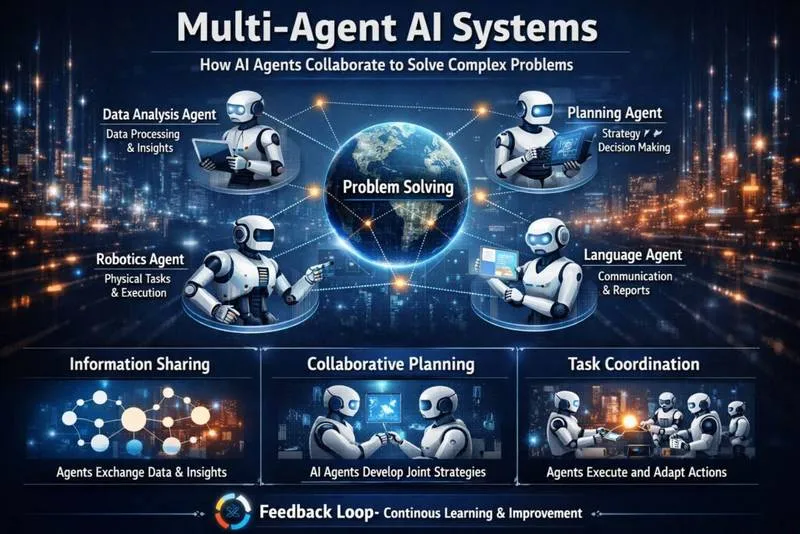
Popular Multi-Agent AI Frameworks
Several frameworks make it easier to build AI teams.
CrewAI
<AsyncImageGroup query={[“CrewAI AI framework logo”,”CrewAI multi agent framework diagram”]} layout=carousel/>
CrewAI allows developers to assign different roles to multiple AI agents.
It focuses on teamwork and organized task management.
AutoGen
<AsyncImageGroup query={[“Microsoft AutoGen AI framework logo”,”AutoGen multi agent conversation diagram”]} layout=carousel/>
AutoGen, developed by Microsoft, enables AI agents to communicate with each other automatically.
It supports collaborative workflows for coding, planning, and problem-solving.
LangGraph
<AsyncImageGroup query={[“LangGraph AI framework graph workflow”,”LangGraph logo AI framework”]} layout=carousel/>
LangGraph helps developers build structured AI workflows where agents interact through connected decision paths.
Each framework offers a different approach, but they all support coordinated AI collaboration.
Challenges of Multi-Agent AI
Despite its advantages, this technology still has limitations.
- Coordination between agents can become complicated.
- More agents may increase computing costs.
- Poor communication between agents can reduce efficiency.
- Security and data privacy remain important concerns.
Developers continue working on solutions to make these systems more reliable and scalable.
What Does the Future Look Like?
The future of AI appears increasingly collaborative.
Instead of interacting with one intelligent assistant, users may soon work with an invisible team of AI specialists behind the scenes.
For example, you could ask AI to launch a business, create a website, analyze competitors, write marketing content, and test the final product. Rather than one model handling everything alone, multiple AI agents could coordinate those tasks automatically.
As research continues, Multi-Agent AI Systems are expected to play a larger role in software development, business automation, robotics, education, and many other industries.
Final Thoughts
A Multi-Agent AI System is more than just another AI trend. It represents a shift from individual intelligence to collaborative intelligence.
By dividing work among specialized agents, these systems can improve accuracy, speed, and problem-solving for complex tasks. While challenges such as coordination and computing costs still exist, frameworks like CrewAI, AutoGen, and LangGraph are making AI teamwork increasingly practical.
As AI technology evolves, the most powerful assistant may no longer be a single AI. Instead, it could be an entire team of intelligent agents working together behind the scenes to deliver better results.
Also Read This
- Samsung Galaxy Tab S12 Ultra Teased: Expected Specs, Launch Date & Price
- Titan Watch Expansion: Luxury Market Move Signals a Bigger Global Ambition
- Tata Sierra Pure Plus L Diesel Automatic Dark Edition Review (2026): Real-World Pros, Cons & Reality Check
- OnePlus 16 Glowing Rear Lights Look Even Better in Action
- MrBeast’s $10 Million Ghana Village Project: Philanthropy, Child Labour, and the Backlash Explained