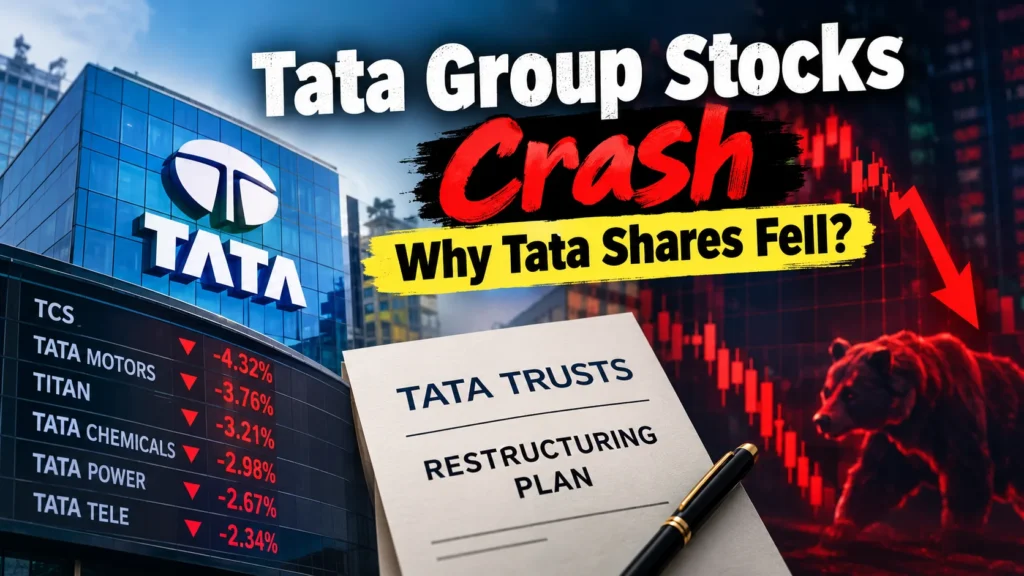
Tata Group Stocks Crash has become a major talking point in the Indian stock market after several Tata Group companies came under selling pressure. The trigger is linked to a major restructuring proposal from Tata Trusts involving Tata Sons, the holding company of the Tata Group.
The development is important because Tata Sons has been facing a regulatory issue with the Reserve Bank of India (RBI). The company is currently classified as an Upper Layer Non-Banking Financial Company (NBFC-UL). After the RBI rejected Tata Sons’ request to surrender its registration, the company moved closer to a mandatory stock-market listing.
Now, Tata Trusts has proposed another route. The plan could change the structure and business profile of Tata Sons and potentially allow it to remain a private, unlisted company.
Tata Trusts Official Announcement
What Caused the Tata Group Stocks Crash?
The latest market reaction is closely linked to Tata Trusts’ strategic reorganisation proposal announced on September 28, 2026.
Tata Trusts, which holds a 66% stake in Tata Sons, has proposed merging two operating companies with Tata Sons:
- Tata Electronics Systems Solutions Private Limited (TESS)
- Tata Consulting Engineers (TCE)
The objective is to increase the operating business and revenue inside Tata Sons. According to Tata Trusts, the restructured company would aim to fall outside the RBI’s NBFC and Core Investment Company (CIC) classifications.
If the restructuring receives the required approvals and changes Tata Sons’ regulatory status, the mandatory listing requirement could potentially be removed.
However, this is still a proposal. It has not been completed.
Why Does Tata Sons Need to Change Its Structure?
Tata Sons is the principal holding company of the Tata Group. It owns stakes in several major Tata businesses and plays a central role in the group’s overall structure.
The RBI classifies Tata Sons as an Upper Layer NBFC. This classification comes with additional regulatory requirements, including a listing requirement under the applicable framework.
In September 2026, the RBI rejected Tata Sons’ application to surrender its registration. This decision increased the pressure on the company to comply with the regulatory framework.
That is why the Tata Trusts’ latest restructuring proposal has attracted so much attention.
What Exactly Is Tata Trusts’ New Plan?
The basic idea is quite simple.
Tata Sons currently functions mainly as the group’s holding company, with a large part of its assets connected to investments in Tata Group companies.
Under the proposed restructuring, TESS and TCE would become part of Tata Sons through a merger.
This would give Tata Sons more direct operating businesses and operating revenue.
Tata Trusts says the proposed structure would help Tata Sons become neither an NBFC nor a CIC. The Trusts also say this would preserve Tata Sons as a private, unlisted company.
The proposal would require approval from the Tata Sons board and a prior no-objection certificate from the RBI.
So, the final outcome is not decided yet.
Why Were Investors Expecting a Tata Sons IPO?
For years, investors have followed the possibility of a Tata Sons listing because of the value of its stakes in major Tata companies.
A public listing could potentially give investors a direct way to participate in Tata Sons. It could also provide a market-based valuation for the holding company.
The RBI’s recent decision made the listing possibility more immediate. As a result, some investors were watching the situation for potential value unlocking.
The new restructuring proposal changes that expectation.
If Tata Sons successfully changes its regulatory status and remains private, the expected listing could be delayed or may no longer be required under the same regulatory framework. This is one reason why investors reacted negatively to the latest development.
Which Tata Stocks Came Under Pressure?
Several Tata Group stocks declined after news of the proposed restructuring became public.
Reuters reported declines in companies including Tata Motors Passenger Vehicles, Tata Investment Corporation, Tata Chemicals, Trent and Tata Consultancy Services (TCS) during the September 29 market reaction. Tata Investment Corporation and Tata Chemicals were among the stocks that saw notable pressure.
Other market reports also highlighted declines across Tata Group counters, with Tata Chemicals and Tata Motors Passenger Vehicles among the stocks that came under pressure during early trading.
The reaction does not mean that the underlying businesses of these companies suddenly became weaker.
Instead, the immediate concern is related to the potential impact of the Tata Sons restructuring on future value unlocking, ownership structure and the group’s overall corporate structure.
Why Could the End of an IPO Expectation Affect Tata Stocks?
This is mainly about expectations.
Investors often consider the potential value of a company’s stake in another business while valuing a holding company.
Tata Sons has significant interests across the Tata Group. A future listing could have provided a public market valuation for Tata Sons itself.
If the company remains private after restructuring, investors may no longer have the same near-term listing event to focus on.
This can affect sentiment around companies that have a connection to Tata Sons’ value.
However, it is important to remember that stock prices are influenced by many factors. Global markets, company earnings, interest rates, sector trends and investor sentiment can also move Tata stocks.
Therefore, it would be too simplistic to say that the entire fall in Tata shares was caused only by the Tata Trusts proposal.
Tata Trusts vs Tata Sons: Why Is the Issue Important?
The restructuring proposal comes at a time when there are differences between Tata Trusts and the Tata Sons board over the future structure of the holding company.
Tata Trusts has publicly stated that it does not agree with listing Tata Sons and wants to explore alternatives. The Trusts said the Tata Sons board had already decided in March 2024 that the company should remain unlisted.
The latest proposal is therefore part of a wider discussion about how Tata Sons should be structured in the future.
At the same time, the proposed merger still needs regulatory and corporate approvals. That means investors will be watching the next steps closely.
What Happens If the Proposal Gets Approved?
If the proposal receives the necessary approvals, Tata Sons could have a larger operating business alongside its existing investment activities.
That could change the company’s financial and regulatory profile.
The Tata Trusts proposal says the reorganised entity would no longer qualify as an NBFC or CIC. The plan also involves Tata Sons seeking the required RBI approval and taking further steps regarding its existing registration.
In that situation, the regulatory basis for a mandatory listing could change.
But this is an expected outcome of the proposal, not a completed fact.
What Happens If the Proposal Is Not Approved?
If the restructuring does not receive the required approvals, Tata Sons would still have to deal with the RBI’s existing regulatory requirements.
That could keep the listing issue alive.
The next important steps will therefore include the response of the Tata Sons board and the RBI’s view of the proposed restructuring.
For investors, these decisions could be more important than the initial market reaction.

Why This Story Matters for Investors
The Tata Group is one of India’s largest business groups, with companies operating across technology, automobiles, consumer products, chemicals, steel, retail, travel and other sectors.
Because Tata Sons sits at the centre of this structure, changes involving the holding company can influence investor expectations across several listed Tata companies.
The current market reaction is mainly connected to uncertainty around the Tata Sons listing and the possible change in its corporate structure.
Investors should also remember that a short-term share-price reaction does not automatically indicate a permanent change in the fundamentals of an individual Tata company.
Each listed company has its own business performance, earnings, debt levels, valuation and future growth prospects.
The Bottom Line
The Tata Group Stocks Crash story is closely linked to the future of Tata Sons.
Tata Trusts has proposed merging Tata Electronics Systems Solutions (TESS) and Tata Consulting Engineers (TCE) with Tata Sons. The goal is to change the company’s business and regulatory structure so that it can potentially remain a private, unlisted company.
The proposal comes after the RBI rejected Tata Sons’ request to surrender its registration, increasing the importance of the listing issue.
For the stock market, the key concern is simple: if Tata Sons does not need to list after restructuring, the expected IPO and possible value unlocking could be delayed or removed.
For now, however, the restructuring is only a proposal. The Tata Sons board and the RBI still have important roles to play.
So, the next few steps could be crucial for Tata Sons and for investor sentiment across several Tata Group stocks.
Note: Tata Group Stocks Crash: This article is for informational purposes only and should not be treated as investment advice. Stock prices can move because of several factors, and investors should conduct their own research before making financial decisions.
Also Read This
- OnePlus N6 Lite vs iQOO Z11 Lite 5G: Which Is the Best Phone Under ₹20,000?
- Amazon Pay India FY26 Financials: Revenue Grows 18% While Losses Climb to Rs 1,149 Crore
- Trump Strait: Why Trump’s Hormuz Map Is Fueling a New US-Iran Standoff
- Starbucks Dual Shift: India Tech Expansion Meets 250 Store Closures and 900 Job Cuts in North America
- Upcoming SUVs India 2026: Honda, Renault, Hyundai and Tata Prepare Exciting New Launches