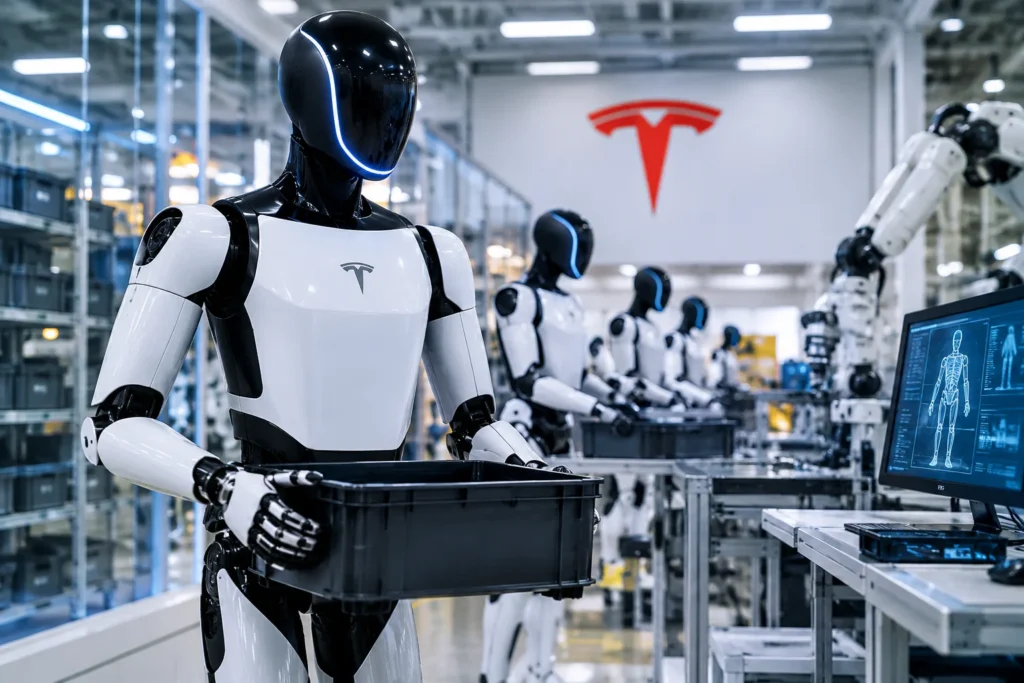
Tesla Optimus Robots Tesla is moving closer to a major milestone with its ambitious humanoid robot project, Optimus. According to recent reports, the company is approaching the ability to produce around 1,000 Optimus robots every week. On paper, that sounds like a huge breakthrough. However, the real story goes far beyond production numbers.
Building thousands of robots is an impressive engineering achievement. Teaching those robots to perform useful tasks in unpredictable real-world environments is a much bigger challenge. While Tesla continues to improve manufacturing speed, the company still faces difficult questions about intelligence, adaptability, and affordability.
If Optimus succeeds, it could change factories, warehouses, and even homes. Yet experts agree that general-purpose humanoid robots are still in their early development phase.
Why Tesla Optimus Matters
Tesla introduced Optimus with a bold vision. Instead of creating a robot for one specific job, the company wants a humanoid machine that can perform many different tasks just like a person.
The long-term goal includes helping with factory work, moving objects in warehouses, assisting businesses, and eventually handling everyday household chores. If successful, this could reduce repetitive labor and increase productivity across multiple industries.
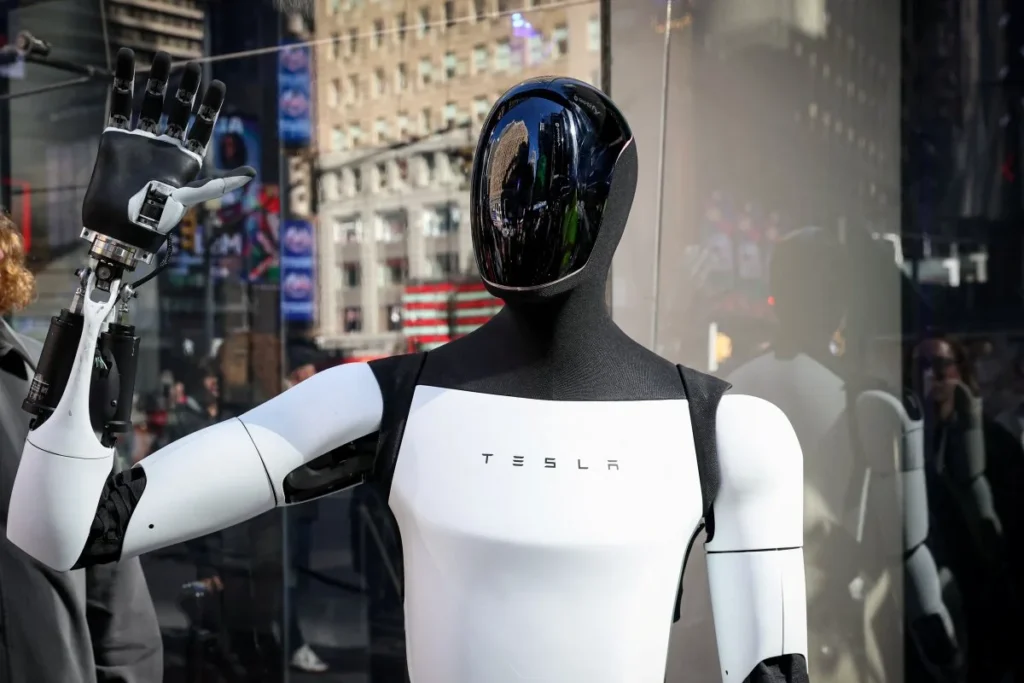
Unlike many industrial robots that stay fixed in one place, Optimus is designed to walk, carry objects, and interact with environments built for humans.
Tesla Is Increasing Production Fast
Tesla has built a reputation for scaling manufacturing quickly. The company’s experience with electric vehicles gives it an advantage when creating production lines for new products.
Reports suggest that Tesla is moving toward 1,000 Optimus robots per week, showing that manufacturing capacity is improving rapidly.
However, high production does not automatically mean the robots are ready for widespread use. A warehouse full of robots only becomes valuable when those machines can complete useful work consistently and safely.
That is why the next stage is more important than simply producing larger numbers.
The Biggest Question Is Utility, Not Quantity
The most important challenge for Optimus is practical usefulness.
A robot must do more than walk across a room. It needs to complete tasks without constant human supervision. It should recognize objects, avoid obstacles, adjust to changing situations, and finish jobs efficiently.
For example, a factory worker can quickly adapt when parts are slightly misplaced. A robot often struggles because small environmental changes can confuse its decision-making system.
This gap between impressive demonstrations and everyday reliability remains one of the biggest obstacles.
Why Real-World Tasks Are So Difficult
Modern AI has made enormous progress in language, vision, and decision-making. Still, the physical world creates problems that software alone cannot easily solve.
Fine Motor Skills Remain a Major Challenge
Humans perform delicate actions without thinking.
Plugging in a cable, tightening a small bolt, folding clothes, or picking up fragile objects requires careful pressure control and precise coordination.
For robots, these seemingly simple actions remain surprisingly difficult because they require accurate sensing, balance, and continuous adjustment.
Unpredictable Environments Create Problems
Factories usually provide controlled conditions.
Real life does not.
Different lighting, dust, moving people, uneven floors, and unexpected obstacles force robots to make rapid decisions.
A robot that performs perfectly in one environment may struggle somewhere else without additional training.
Adaptability Is Still Limited
People naturally use common sense.
If a box is moved to another shelf, a worker can quickly find it.
Many robots still rely on learned patterns rather than flexible reasoning. When conditions change significantly, they often need additional training or updated software.
Improving this adaptability remains one of the industry’s biggest research challenges.
Can AI Solve These Problems?
Tesla continues investing heavily in artificial intelligence.
The company combines computer vision, neural networks, and machine learning to help Optimus understand its surroundings. Instead of depending only on pre-programmed instructions, the robot learns from large amounts of data and practice.
This approach has already improved object recognition and movement planning.
However, researchers point out that physical intelligence develops much more slowly than digital intelligence. Understanding words is very different from safely carrying heavy objects or navigating crowded spaces.
In other words, smarter software helps, but it does not instantly solve every real-world challenge.
Cost Will Decide the Future
Another important factor is affordability.
A powerful robot becomes much more valuable if businesses can actually afford to buy it.
Tesla’s long-term vision appears to focus on reducing production costs through large-scale manufacturing, similar to its strategy for electric vehicles.
If prices fall enough, factories and warehouses could become early adopters. Household adoption, however, would likely require even lower prices and much higher reliability.
For now, cost remains an important question that has not been fully answered.
Where Optimus Could Be Used First
Instead of immediately replacing workers everywhere, Optimus will likely succeed first in environments where tasks are repetitive and predictable.
Potential early applications include:
- Moving materials inside factories
- Carrying boxes in warehouses
- Organizing inventory
- Assisting with simple assembly tasks
- Supporting workplace logistics
These jobs offer structured environments where robots can operate more safely and consistently.
Homes present a much greater challenge because every household is different.
The Next Five Years Could Be Crucial
The next few years may determine whether humanoid robots become practical tools or remain limited demonstrations.
If Tesla continues improving hardware, AI, and manufacturing together, Optimus could become increasingly useful in industrial settings.
Even then, experts generally expect gradual adoption rather than an overnight revolution. Businesses usually introduce new technologies step by step, especially when safety and reliability are critical.
That means widespread household robots are still likely to require additional breakthroughs before becoming common.
Final Thoughts
Tesla reaching nearly 1,000 Optimus robots per week would represent a significant manufacturing milestone. It demonstrates the company’s ability to scale production and push ambitious engineering projects forward.
At the same time, the hardest part of the journey is only beginning.
Real success will depend on whether Optimus can become reliable, adaptable, affordable, and genuinely useful in everyday work. Until then, the future of humanoid robots remains exciting, but the gap between hype and reality is still very real.
Also Read This
- From Ordinary Screen to 1 Crore a Year: How Dubai Content Creators Build a Successful Business
- Next Action Prediction in AI Robots: How VLASH Helps Robots Think Ahead
- Apple Faces $5.7 Billion Patent Verdict Over iPhone and Apple Watch Haptic Technology, Plans to Appeal
- Vivo Y600i Review: Is the 8,000mAh Battery Phone Really Worth Buying?
- 5 Best AirPods Pro 3 Alternatives in 2026: Top Wireless Earbuds for Every Budget