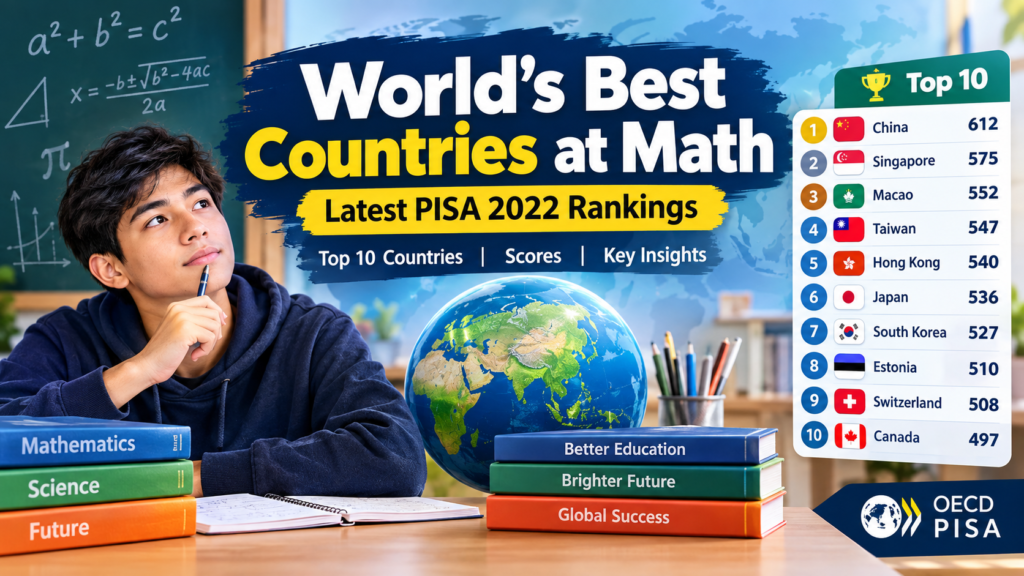
World’s Best Countries at Math: For generations, students around the world have wondered which countries produce the strongest math minds. While many of us struggled with algebra formulas or geometry problems in school, some education systems consistently deliver world-class mathematical skills.
The latest OECD PISA 2022 results provide one of the clearest answers yet. The assessment tested more than 760,000 students aged 15 across 81 participating countries and economies, measuring how well they apply mathematics to real-life situations instead of simply memorizing formulas.
The results reveal a clear pattern. East Asian education systems continue to dominate global math performance, while many developed countries have seen noticeable declines over the past decade.
What Is the PISA Assessment?
The Programme for International Student Assessment (PISA) is an international study conducted by the Organisation for Economic Co-operation and Development (OECD) every three years.
Instead of testing textbook memorization, PISA evaluates whether students can use mathematics to solve practical problems, analyze information, and think logically in unfamiliar situations.
Because of this approach, PISA has become one of the world’s most respected education benchmarks.
World’s Best Countries at Math: click here

Top 10 Countries with the Best Math Performance
The latest rankings show that Asian countries and economies dominate the global leaderboard. Seven of the top ten positions belong to East Asia.
| Rank | Country/Economy | Math Score |
|---|---|---|
| 1 | China (Beijing, Shanghai, Jiangsu, Zhejiang) | 612 |
| 2 | Singapore | 575 |
| 3 | Macao | 552 |
| 4 | Chinese Taipei (Taiwan) | 547 |
| 5 | Hong Kong | 540 |
| 6 | Japan | 536 |
| 7 | South Korea | 527 |
| 8 | Estonia | 510 |
| 9 | Switzerland | 508 |
| 10 | Canada | 497 |
Note: China’s score represents students from Beijing, Shanghai, Jiangsu, and Zhejiang rather than the entire country.
Why East Asia Continues to Lead
The rankings are not simply about students studying longer hours. Experts point to several common factors shared by these top-performing education systems.
Strong Foundations
Countries like Singapore and Japan focus heavily on mastering basic concepts before moving to advanced topics. Students build confidence step by step instead of rushing through the syllabus.
Problem-Solving Approach
Many classrooms encourage students to understand why a solution works instead of memorizing shortcuts. This develops deeper mathematical thinking.
Consistent Practice
Regular practice and structured learning help students improve analytical skills over time.
How Western Countries Compare
Several Western nations still perform well, but many now rank below the highest-performing Asian education systems.
Canada
Canada ranks 10th globally with 497 points, making it one of the strongest-performing Western countries.
Switzerland
Switzerland secures 9th place with 508 points, showing strong mathematical performance across its education system.
United Kingdom
The United Kingdom scores 489 points, placing it outside the global top ten but still above many OECD countries.
United States
The United States records 465 points, which is close to the OECD average and significantly lower than the highest-performing countries.
Australia and New Zealand
Australia scores 487 points, while New Zealand reaches 479 points, placing both countries in the middle of the higher-performing group.
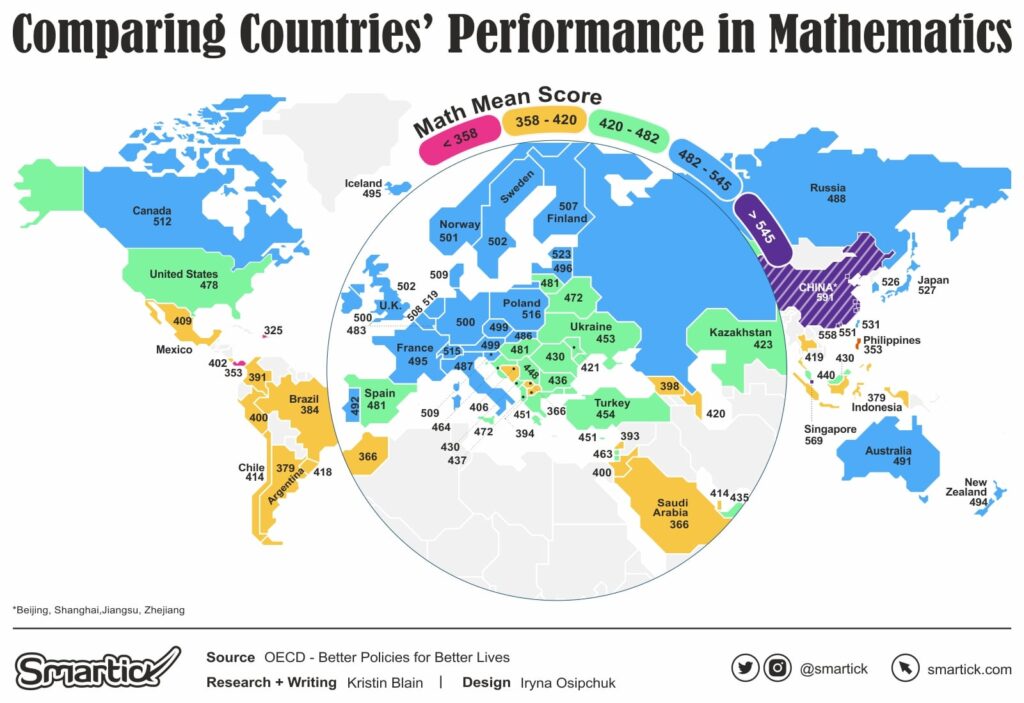
The Bigger Story: Global Math Scores Are Falling
One of the biggest findings from PISA 2022 is that mathematics performance has declined in many parts of the world.
Across OECD countries, average math scores have fallen by around 15 points compared with 2018, marking one of the largest declines ever recorded in the assessment’s history.
Education experts believe several factors contributed to this trend.
Pandemic Learning Disruptions
School closures and remote learning affected millions of students, making it harder to build strong mathematical foundations.
Increased Screen Time
Research linked with PISA suggests that students who spend excessive time on entertainment-based screen activities often perform worse academically, although many factors influence learning outcomes.
Reduced Attention Span
The growing popularity of short-form digital content may make sustained concentration more challenging for some students, according to education researchers.
What Makes Singapore’s Math System Special?
The country’s famous Singapore Math method focuses on understanding concepts before memorizing formulas.
Students often learn through a three-step process.
- First, they use real objects.
- Next, they work with visual models.
- Finally, they solve abstract equations.
This approach has influenced schools in many other countries.
Estonia: Europe’s Top Performer
Among European countries, Estonia stands out as the highest-ranked performer.
The country’s education system combines modern teaching methods, equal access to education, and strong teacher training, helping students achieve excellent results without relying solely on intensive exam preparation.
Why These Rankings Matter
Mathematics is much more than classroom calculations.
Strong math skills help people in science, technology, engineering, finance, artificial intelligence, and everyday decision-making. As industries become more data-driven, analytical thinking has become one of the most valuable skills for future careers.
Countries that invest in mathematical literacy are also investing in long-term innovation and economic growth.
What Can Other Countries Learn?
The world’s highest-performing education systems share several practical lessons.
- Build strong basics before advanced topics.
- Encourage conceptual understanding instead of rote memorization.
- Give students regular opportunities to solve real-world problems.
- Support teachers with quality training and classroom resources.
- Maintain a healthy balance between technology use and focused learning.
These strategies may help improve mathematical confidence across different education systems.
Final Thoughts
The latest PISA 2022 rankings make one thing clear. East Asian education systems continue to set the global standard for mathematics, while many countries are working to reverse recent declines in student performance.
Whether it is Singapore’s concept-based teaching, Japan’s disciplined learning culture, or Estonia’s balanced education model, the common message is simple: strong analytical thinking develops through consistent practice, quality teaching, and a solid understanding of fundamentals.
As education continues to evolve, the biggest challenge is not making math easier. It is making math more meaningful, practical, and engaging for every student.
Source: OECD PISA 2022 (Programme for International Student Assessment)
World’s Best Countries at Math.
Also Read This
- Explained: How Trump’s Greenland Deal Strengthens US Power and Challenges Russia and China
- Tata Motors Sales August 2026: Punch, Nexon, Tiago, Sierra, Harrier & Altroz Full Report Card
- Redmi Note 17 Pro vs OnePlus Nord CE6: Which Phone Is Better Under ₹40,000?
- China’s YouTube Bilibili: Why Indian Creators Are Joining Despite No Official India Launch
- ColorOS 17 for OPPO Find X9 Series and OnePlus 15: Features, AI Upgrades, and October Rollout