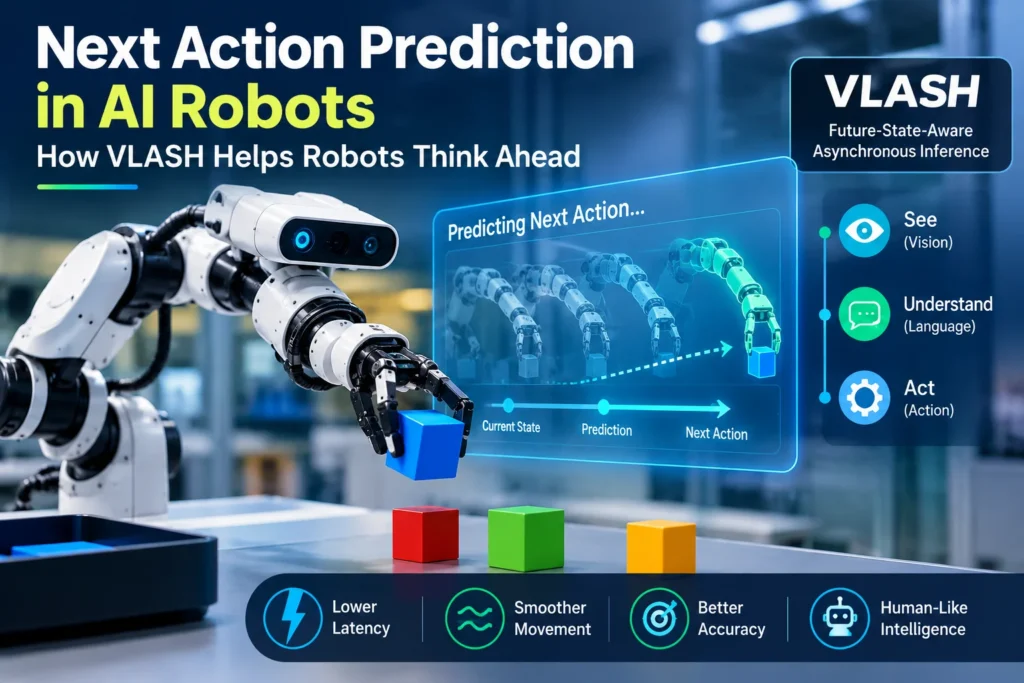
Next Action Prediction in AI Robots: How Robots Predict Their Next Move
Next Action Prediction: Imagine a robot catching a flying ball, playing table tennis, or moving smoothly beside a factory worker without stopping to think after every step. A few years ago, this sounded like science fiction. Today, new AI robotics research is making it much more realistic.
One of the biggest breakthroughs behind this progress is Next Action Prediction, a concept that helps robots predict where they will be in the near future before making their next move. A research framework called VLASH (Future-State-Aware Asynchronous Inference) is designed to reduce delays between thinking and acting.
Instead of waiting for every calculation to finish, the robot keeps moving while its AI prepares the next action. This simple idea makes robotic movement much faster, smoother, and closer to human behavior.
Why Latency Was a Big Problem for Robots
For years, robots struggled with one hidden issue called latency.
Latency is the small delay between seeing something and reacting to it. Even a delay of a few milliseconds can become a serious problem when a robot works in a fast-changing environment.
Traditional AI-powered robots usually followed a synchronous process.
The robot first looked at the environment using cameras and sensors. Then its Vision-Language-Action (VLA) model processed the information. Finally, after finishing the calculation, it executed the action.
Although this process sounds fast, reality is different. By the time the robot finished thinking, the object or even the robot’s own arm had already moved.
This caused hesitation, missed targets, and unnatural movement.
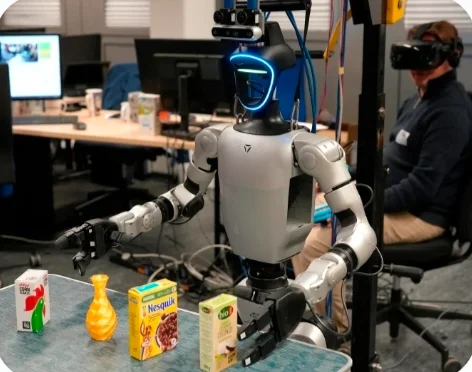
The Old Robot Workflow
A traditional robot usually worked like this:
- Camera captures the scene.
- AI analyzes the situation.
- The model decides the next action.
- The robot performs the movement.
- The cycle starts again.
This stop-and-go approach worked for slow tasks, but it became inefficient for high-speed activities.
For example, a robot could not easily return a fast table tennis shot or catch a moving object because every action included a small pause.
What Is VLASH?
VLASH stands for Future-State-Aware Asynchronous Inference.
The framework introduces a smarter way of controlling robots.
Instead of stopping while the AI thinks, the robot continues moving. Meanwhile, the AI predicts where the robot’s body will already be when the calculation finishes.
This creates much smoother movement.
Think of it as planning one step ahead instead of reacting after every step.
How Future-State Awareness Works
The most important part of VLASH is Future-State Awareness.
While the AI calculates the next command, it also estimates the robot’s future position.
Imagine a robotic arm reaching toward a cup.
Without prediction:
- The robot sees the cup.
- It pauses.
- It calculates.
- It reaches.
With VLASH:
- The robot keeps moving.
- The AI predicts where the arm will be a moment later.
- The next command is adjusted before it arrives.
- The movement stays smooth.
This prediction removes much of the delay caused by computation.
What Is Asynchronous Inference?
Asynchronous Inference is another key part of VLASH.
The word “asynchronous” simply means that two processes happen at the same time instead of waiting for each other.
In older robots:
- Think first.
- Move later.
In VLASH-powered robots:
- Think while moving.
- Update continuously.
This overlap makes the robot feel much more responsive.

Why It Feels More Like Human Intelligence
Humans rarely stop before every movement.
When you drive a bicycle, catch a cricket ball, or climb stairs, your brain constantly predicts what will happen next.
You are already preparing your next action before finishing the current one.
Robots using Future-State Awareness behave in a similar way.
They continuously estimate future positions and adjust their movements in real time.
This creates more natural motion.
The Role of Vision-Language-Action (VLA) Models
Modern robots often use Vision-Language-Action (VLA) models.
These AI systems combine three abilities:
- Vision: Understand images from cameras.
- Language: Interpret human instructions.
- Action: Convert understanding into physical movement.
For example, if someone says:
“Pick up the blue bottle.”
The VLA model first recognizes the bottle, understands the spoken command, and plans the movement needed to grab it.
VLASH improves this process by making the action planning aware of the robot’s future position.
Where This Technology Can Be Used
Next Action Prediction has practical benefits across many industries.
Manufacturing
Factory robots can work on moving conveyor belts with fewer pauses.
They can adjust to changing positions
Also Read This
- Trump Strait: Why Trump’s Hormuz Map Is Fueling a New US-Iran Standoff
- Starbucks Dual Shift: India Tech Expansion Meets 250 Store Closures and 900 Job Cuts in North America
- Upcoming SUVs India 2026: Honda, Renault, Hyundai and Tata Prepare Exciting New Launches
- Tata Group Stocks Crash: Why Tata Trusts’ New Move Shook the Market
- From Ordinary Screen to 1 Crore a Year: How Dubai Content Creators Build a Successful Business