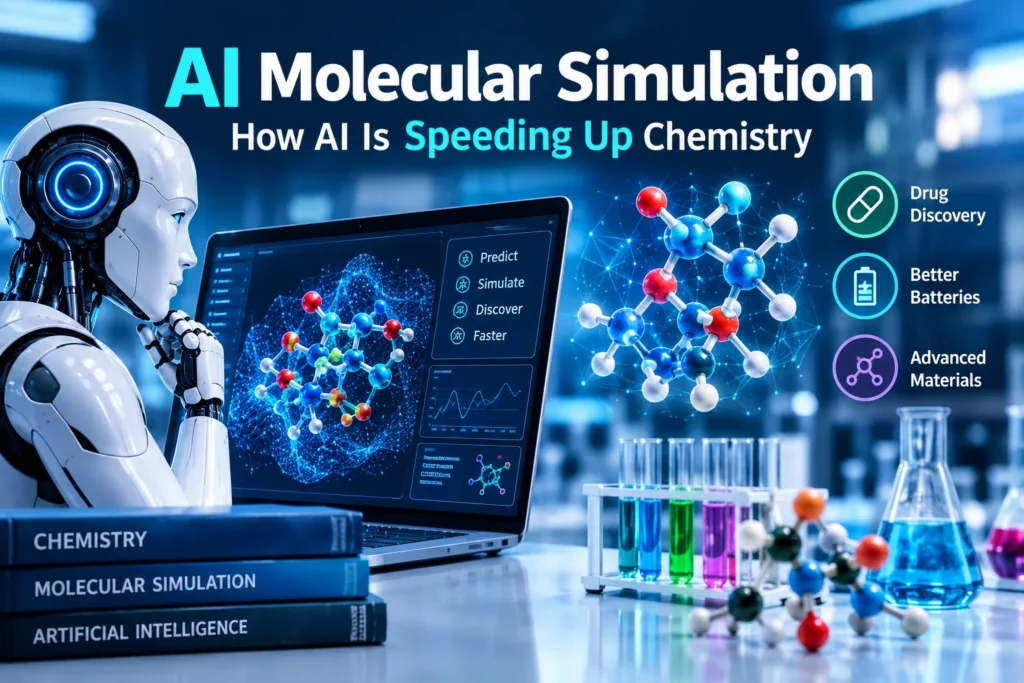
AI Molecular Simulation: When most people hear the term Artificial Intelligence (AI), they usually think about chatbots, image generators, coding assistants or AI video tools. But AI is now moving far beyond everyday digital applications.
Scientists are increasingly using AI to study molecules, chemical reactions, proteins and advanced materials. One of the most interesting areas is AI-driven molecular simulation, where machine learning models help researchers predict how atoms and molecules behave.
This raises an important question:
Can AI really make chemistry thousands of times faster?
The short answer is that AI can dramatically speed up some types of molecular calculations and screening. In certain specialized simulations, researchers have reported speedups of several orders of magnitude compared with specific quantum-mechanical methods. However, there is no single number that applies to all chemistry problems.
So, what is actually happening behind the scenes? And can AI really transform drug discovery, batteries and materials science?
Let’s break it down.
Why Is Traditional Molecular Research So Time-Consuming?
Before understanding the role of AI, it is important to understand why molecular research can take so much time.
Scientists working on new medicines, battery materials, catalysts or advanced polymers often need to study how molecules interact with each other.
A single research project can involve thousands or even millions of possible chemical structures.
Testing all of them in a physical laboratory is not practical.
Laboratory experiments take time
Researchers may need to synthesize a compound, test its properties, analyze the results and then modify the molecule.
If the result is not good enough, the process starts again.
This cycle can take weeks, months or even longer depending on the problem.
Experiments can be expensive
Laboratory research requires chemicals, equipment, specialized facilities and trained researchers.
Some experiments also need repeated testing to confirm the results.
This makes large-scale trial and error expensive.
Quantum calculations are computationally demanding
There is another challenge.
Scientists often use computational chemistry methods to understand molecular structures and interactions at the quantum level.
These calculations can become extremely expensive as the size and complexity of the system increases.
That is where machine learning can become useful.
Nature: Machine Learning for Molecular Simulation
How AI Is Changing Molecular Simulation
AI models can learn patterns from large amounts of scientific data.
In molecular simulation, researchers can train machine learning models using information such as molecular structures, energies, forces and other properties generated from experiments or high-accuracy calculations.
Once trained, the model can make predictions much faster for certain tasks.
Instead of performing an expensive calculation from scratch every time, an AI model can approximate the underlying relationship it has learned from previous data.
This approach is particularly interesting for machine-learning interatomic potentials, which can learn how atoms interact from reference quantum-mechanical calculations.
AI Can Learn How Atoms Interact
Imagine a computer trying to understand a complex molecular system.
It needs to estimate how the atoms move, how strongly they interact and how the system’s energy changes when the atoms change position.
Traditional quantum-mechanical calculations can be highly demanding.
A trained machine-learning model can sometimes estimate these properties much more efficiently.
This does not mean the AI has replaced the laws of physics.
Instead, it has learned a mathematical approximation of relationships found in high-quality scientific data.
That distinction is important.
AI is not simply guessing what molecules will do. Properly trained scientific models are designed around physical and chemical information and are tested against reference calculations or experiments.
How Much Faster Can AI Make Molecular Simulations?
This is where the headline claim needs some context.
There is no universal “thousands of times faster” number for AI chemistry.
The actual improvement depends on the type of simulation, the AI architecture, the size of the molecular system, the hardware and the reference method being compared.
However, some research has demonstrated very large improvements.
For example, researchers behind AI²BMD reported that their AI-based biomolecular dynamics approach reduced computational time by several orders of magnitude compared with density functional theory for the systems studied. The work also demonstrated simulations involving proteins containing more than 10,000 atoms.
This is an important result, but it should not be interpreted as saying that every chemical calculation can now be completed thousands of times faster.
The real benefit is that AI can make some previously expensive calculations much more practical.
Nature: AI Molecular Simulation Research
From Millions of Molecules to a Smaller Shortlist
One of the biggest advantages of AI may not be replacing laboratory experiments.
Instead, it can help researchers decide which experiments are worth doing.
Consider drug discovery.
Scientists may have a huge library of potential molecules. Testing every compound experimentally would take enormous amounts of time and money.
AI can help predict which candidates are more promising.
Researchers can then take a smaller group of candidates into further computational analysis and laboratory testing.
This process can reduce the number of experiments needed in the early stages.
AI-based virtual screening is already being investigated for large-scale drug discovery, although computational predictions still require careful validation.
AI Is Also Being Used for Materials Discovery
The potential applications go beyond medicines.
Researchers are using machine learning to search for new materials with useful properties.
These could include:
- Better battery materials
- New catalysts
- Stronger materials
- Semiconductor materials
- Solar-cell materials
- Advanced polymers
- Materials for energy storage
Large AI models can examine huge chemical and materials spaces that would be difficult to explore using traditional methods alone.
For example, Google’s GNoME research used deep learning to search for new inorganic crystal structures and reported the discovery of many potentially stable materials. The researchers also highlighted the challenge of predicting properties outside the chemical space represented in training data.
This shows both the opportunity and the challenge of AI-powered materials discovery.
AI Can Help With Quantum Chemistry Too
Another fascinating area is the use of deep learning for quantum chemistry.
Quantum mechanical calculations are extremely useful because they can provide detailed information about electrons, chemical bonds and molecular energies.
But they can also become computationally expensive.
Researchers are exploring neural networks that can approximate parts of these calculations.
Google DeepMind, for example, has published work on deep-learning approaches for quantum chemistry and electronic structure calculations. These methods are designed to capture important physical behaviour while reducing some of the computational burden.
The goal is not to remove physics from chemistry.
The goal is to use AI to make difficult calculations more scalable.
But There Is a Big Catch: AI Is Only as Good as Its Data
This is one of the most important points in AI-driven science.
A machine-learning model learns from data.
If the training data are incomplete, biased, noisy or poorly representative of the real problem, the model can produce unreliable predictions.
This is particularly difficult in drug discovery.
Biological systems are highly complex, and experimental results can depend on many factors.
A molecule that performs well in one laboratory test may behave differently in another biological environment.
Recent research has highlighted data quality, bias, model validation and the difficulty of translating computational predictions into real-world drug development as major challenges for AI in this field.
A Computer Prediction Is Not the Same as a Laboratory Result
This is another important reality check.
Suppose an AI model predicts that a particular molecule could be a promising drug candidate.
That does not mean the molecule is automatically a successful medicine.
Scientists still need to synthesize the compound and test it.
Depending on the development stage, researchers may need to study properties such as:
- Chemical stability
- Binding behaviour
- Toxicity
- Pharmacokinetics
- Biological activity
- Dosage
- Safety
- Effects in relevant biological models
Eventually, successful drug candidates must go through clinical development and regulatory processes.
So AI can help narrow down the possibilities, but it cannot simply skip the experimental process.
AI and Scientists Are Better Together
The most realistic future is not a competition between AI and scientists.
It is a combination of both.
AI can perform certain computational tasks quickly and analyze enormous datasets.
Scientists provide domain knowledge, design experiments, interpret results and decide what questions should be investigated next.
This creates a powerful feedback loop.
AI prediction → Computational simulation → Laboratory experiment → New data → Improved AI model
As this cycle becomes more automated, researchers may be able to explore scientific questions faster.
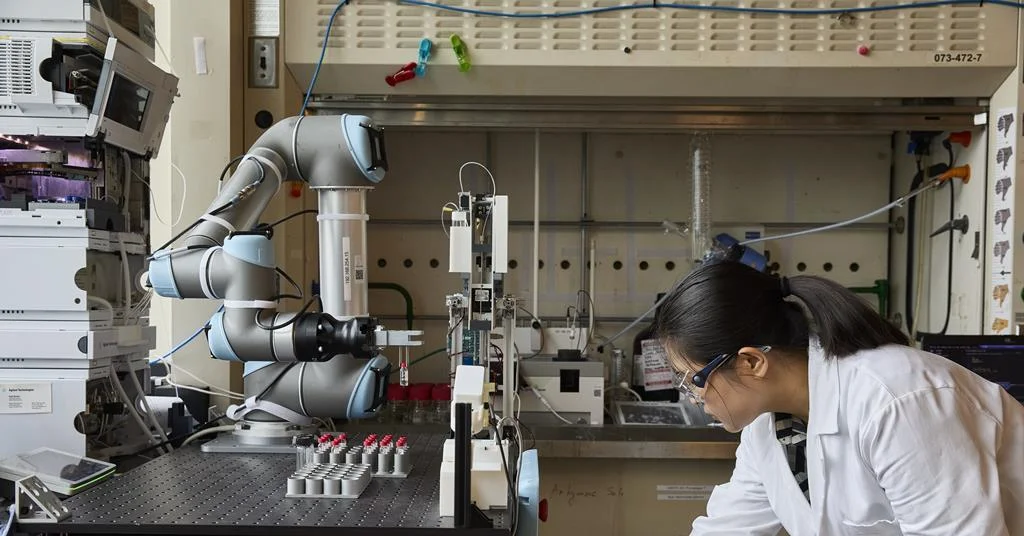
Some emerging research is already moving toward closed-loop systems in which AI, simulation and automated experiments work together.
Could AI Really Change Drug Discovery?
Potentially, yes, but the answer is more complicated than simply saying “AI will make drugs thousands of times faster.”
AI can accelerate individual steps such as molecular screening, structure prediction, property prediction and target identification.
However, the complete drug-development process contains many stages that cannot simply be compressed by improving a computer model.
A 2026 review in Nature Reviews Drug Discovery noted that while AI methods have advanced rapidly, evidence of their broad clinical impact remains limited. The researchers emphasized the gap between better model performance and actual improvements in real-world drug development.
That means the biggest question is no longer only:
“Can AI make a better prediction?”
It is also:
“Does that prediction help scientists make better decisions and develop useful medicines?”
That is a much harder problem.
What About Batteries and Future Energy Technology?
Molecular simulation could also play an important role in energy research.
Battery researchers need to understand how ions move, how materials react and how structures change during charging and discharging.
Simulations can help scientists explore these processes before building and testing every possible material.
AI-based molecular and materials models could therefore help researchers search larger design spaces more efficiently.
This could be useful for future batteries, catalysts, solar materials and other energy technologies.
However, just like in drug discovery, promising computer results still need to be confirmed experimentally.
The Biggest Advantage May Be Cutting Down Failed Experiments
There is a simple way to understand the real value of AI in chemistry.
Imagine researchers have 100,000 possible molecular candidates.
Testing all of them in a laboratory would be unrealistic.
An AI system could potentially help rank or filter these candidates.
Scientists might then focus their expensive experimental resources on a much smaller set.
Even if AI does not produce a perfect prediction every time, reducing the number of unnecessary experiments could still provide significant value.
This is why AI should not always be judged by whether it completely replaces traditional chemistry.
Sometimes its biggest contribution is helping researchers spend their time and resources more intelligently.
So, Can AI Make Chemistry Thousands of Times Faster?
The answer is:
Sometimes, for specific computational tasks, the speedup can reach several orders of magnitude. But it is not accurate to say that AI makes all of chemistry thousands of times faster.
The technology works best when the problem, training data and validation process are well defined.
AI can make molecular simulations faster.
It can help screen chemical libraries.
It can predict molecular and material properties.
It can reduce the number of candidates that need experimental testing.
And it can help scientists explore chemical spaces that would otherwise be difficult to search.
But it still has limitations.
The Future of AI-Driven Molecular Simulation
The future could be much more interesting than simply running simulations faster.
Scientists are increasingly exploring systems where AI models, molecular simulations, automated laboratories and human researchers work together.
In such a workflow, AI could suggest promising molecules or materials.
Simulation could evaluate them.
Robotic laboratory systems could synthesize and test selected candidates.
The results could then be fed back into the AI model.
This could create a continuous scientific discovery cycle.
But the technology still needs better datasets, reliable validation, stronger generalization and careful experimental testing.
Recent research continues to emphasize that impressive computational results do not automatically translate into real-world scientific or clinical success.
AI Molecular Simulation Final Verdict:
AI and molecular simulation are changing the way researchers approach chemistry.
The technology can reduce the computational cost of some difficult simulations and help scientists search enormous numbers of possible molecules and materials.
In specialized cases, the speed improvement can be dramatic.
But the idea that AI has already made all chemistry thousands of times faster is an oversimplification.
The real revolution is more practical.
AI can help scientists explore more possibilities, eliminate weaker candidates earlier and focus laboratory resources on the most promising options.
The laboratory is still essential.
Human scientific judgment is still essential.
And experimental validation is still essential.
The most likely future is therefore not AI versus scientists.
It is AI working alongside scientists.
As molecular simulation, machine learning and laboratory automation continue to improve, this combination could significantly change how new medicines, batteries, catalysts and advanced materials are discovered.
The chemistry lab of the future may not be replaced by AI.
Instead, it may become a place where humans and intelligent machines work together to discover things that would have been far harder to find before.
Also Read This
- Mark Zuckerberg and Priscilla Chan Help Save a 600-Year-Old Hawaiian Fishpond
- Nothing Headphone (1) Pro Review: Is This Premium Over-Ear Headphone Worth It?
- Nothing Headphone (1) Pro V: BTS Star Becomes Global Brand Ambassador
- Spotify Outage: Thousands of Users Report Problems With Music Streaming Service
- Renault’s Hybrid Blitz: 3 New SUVs Coming by 2027, Here’s What We Know