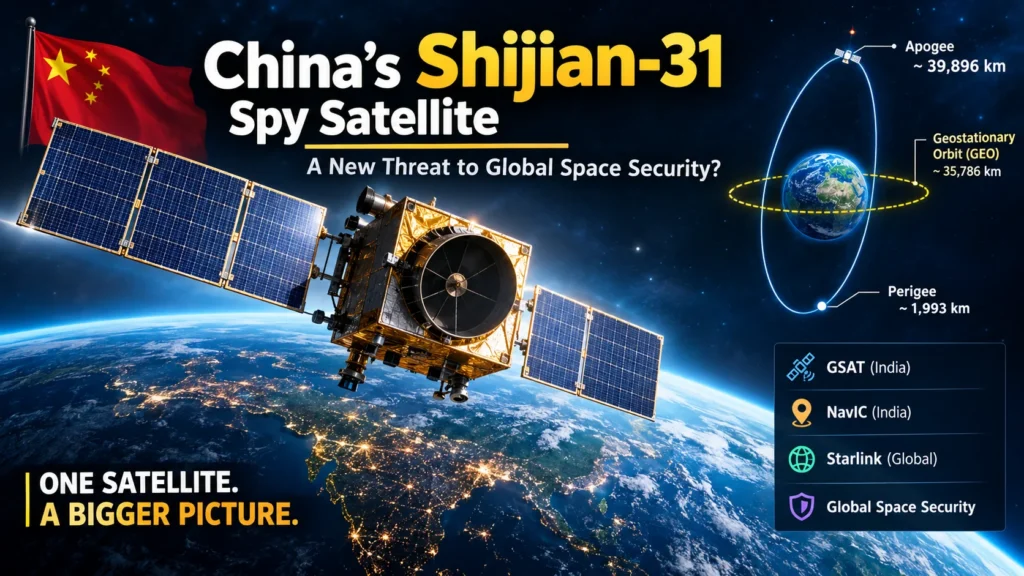
China’s Shijian-31 Spy Satellite: Space has become one of the world’s most important strategic frontiers. Countries now rely on satellites for communication, navigation, weather forecasting, banking, military operations, and internet services. As a result, protecting these valuable assets has become a national security priority.
China’s latest satellite, Shijian-31, has attracted international attention because of its unusual orbit and its potential role in improving China’s space surveillance capabilities. Instead of watching a single location, the satellite appears designed to observe large sections of the Geostationary Earth Orbit (GEO), where many of the world’s most important satellites operate.
While experts continue to study its exact mission, Shijian-31 highlights how competition in space is becoming more sophisticated.
Why Shijian-31 Is Getting Global Attention
China launched Shijian-31 aboard a Long March-3B rocket from the Xichang Satellite Launch Center. According to satellite tracking organizations, the spacecraft entered a highly elliptical orbit that differs from the traditional paths used by most GEO satellites.
Instead of remaining fixed over one point on Earth, Shijian-31 follows a sweeping orbital path that allows it to observe different sections of the GEO belt over time. This has made defense analysts and space experts pay close attention to its capabilities.
Although Chinese authorities have provided limited public details about the satellite’s mission, independent tracking data has revealed several unusual characteristics.

What Makes Shijian-31’s Orbit Different?
The satellite’s orbit is one of its most interesting features.
<list-item marker={}> Inspired by the Molniya orbit: The satellite uses a modified version of the Soviet-era Molniya orbit, which was originally developed for communications over high-latitude regions. <list-item marker={}> A different orientation: Instead of focusing on northern regions, Shijian-31’s orbit places its highest point above the equatorial area, creating a different viewing angle. <list-item marker={}> Large altitude range: Tracking data indicates that the satellite travels from approximately 1,993 km at its closest point to nearly 39,896 km at its farthest point. <list-item marker={}> Systematic coverage: Because its orbit gradually shifts with each pass, it can view different portions of the geostationary belt over a period of about 23 days.
This orbital pattern provides a broad viewing perspective instead of monitoring only one satellite.
Why Is the Geostationary Orbit So Important?
The Geostationary Earth Orbit (GEO) is located around 35,786 kilometers above Earth. Satellites in this orbit match Earth’s rotation, allowing them to remain above the same location continuously.
Many essential services depend on this orbital region, including:
- Television broadcasting
- Weather monitoring
- Military communications
- Disaster management
- Secure government communications
- Regional navigation support
Because so many critical satellites share this orbital belt, any improvement in space surveillance naturally attracts global interest.
Could India’s GSAT and NavIC Be Observed?
India operates several important satellite systems that support national infrastructure.
<AsyncImageGroup query={[“India GSAT communication satellite illustration”,”NavIC Indian navigation satellite illustration”]} layout=carousel/>
The GSAT communication satellites provide broadcasting, communication, and strategic connectivity. Meanwhile, NavIC (Navigation with Indian Constellation) offers regional positioning services designed specifically for India and nearby regions.
Since some Indian satellites operate within or near the GEO environment, they could fall within the viewing range of a satellite that surveys large sections of this orbital region.
However, observing satellites from a distance is different from interfering with them. Publicly available evidence does not show that Shijian-31 has demonstrated offensive capabilities against these systems.
What About Starlink and Other Mega-Constellations?
Unlike GEO satellites, SpaceX’s Starlink operates mainly in Low Earth Orbit (LEO), much closer to Earth.
<AsyncImageGroup query={[“SpaceX Starlink satellites in Low Earth Orbit illustration”,”Earth showing Low Earth Orbit and Geostationary Orbit comparison”]} layout=carousel/>
Even so, experts say that improving Space Situational Awareness (SSA) helps countries better understand how different satellite networks operate across multiple orbital layers.
Tracking satellite movements can provide valuable information for:
- Traffic management in space
- Collision avoidance
- Technical analysis
- Military planning
- Space security research
This broader understanding explains why new surveillance satellites attract international attention.

Is Shijian-31 Part of a Larger Chinese Space Network?
Many analysts believe Shijian-31 fits into China’s broader effort to expand its space monitoring capabilities.
<AsyncImageGroup query={[“Chinese TJS satellite illustration”,”Chinese Shiyan experimental satellite illustration”]} layout=carousel/>
Over recent years, China has launched several experimental satellites, including members of the Shiyan series and TJS satellites.
Some of these missions appear to use paired spacecraft operating in complementary positions. This approach can increase observation time by allowing one satellite to continue monitoring while another moves to a different part of its orbit.
Although many details remain classified, this pattern suggests continued investment in advanced space surveillance technologies.
Why Space Surveillance Matters More Than Ever
Modern societies depend heavily on satellites. Financial transactions, emergency communications, GPS navigation, weather forecasting, aviation, and military operations all rely on space-based infrastructure.
As more satellites enter orbit, countries are investing heavily in technologies that improve awareness of what is happening in space.
Today’s priorities include:
- Monitoring satellite movements
- Preventing orbital collisions
- Detecting unusual spacecraft behavior
- Protecting national space assets
- Improving international coordination
This growing focus reflects how space has become an increasingly competitive strategic domain.
How ISRO Can Strengthen India’s Space Security
<AsyncImageGroup query={[“ISRO satellite control room”,”ISRO communication satellite in space”]} layout=carousel/>
Experts often suggest several practical steps that agencies like ISRO can continue developing to improve satellite security.
Some important measures include:
- Expanding India’s Space Situational Awareness network.
- Improving satellite maneuver capabilities.
- Strengthening cybersecurity for ground stations.
- Building greater redundancy across communication networks.
- Increasing cooperation with friendly space agencies.
- Developing advanced monitoring systems for unusual orbital activity.
These measures focus on resilience rather than reacting to a single satellite mission.
The Future of Orbital Security
Shijian-31 represents another reminder that space technology is evolving rapidly. Whether used for research, monitoring, or strategic awareness, advanced satellites are changing how countries observe the increasingly crowded environment around Earth.
For India, the United States, Europe, Japan, and other space-faring nations, protecting critical infrastructure will require stronger tracking networks, smarter satellite designs, and greater international cooperation.
The next chapter of space competition may not be fought only through rockets and launches. Instead, it may depend on who can best understand and manage the complex environment surrounding our planet.
Also Read This
- Mumbai Man Sells Bitcoin for Rs 1.24 Crore: Why ITAT Quashed the Tax Demand
- Xiaomi 18 Pro Real-Life Images Surface: Why the New Flush Camera Design Changes Everything
- Redmi Note 17 Pro vs OnePlus Nord CE 6 Comparison: Which Phone Offers More Under Rs. 40,000?
- iOS 27 Lets You Watch YouTube on Apple CarPlay: How It Works
- Reliance Ice Cream Launch: Why Bombay Creamery Could Change India’s Frozen Food Market
Shijian-31 Spy Satellite: click here
Shijian-31 Spy Satellite: COMSPOC – Space Situational Awareness