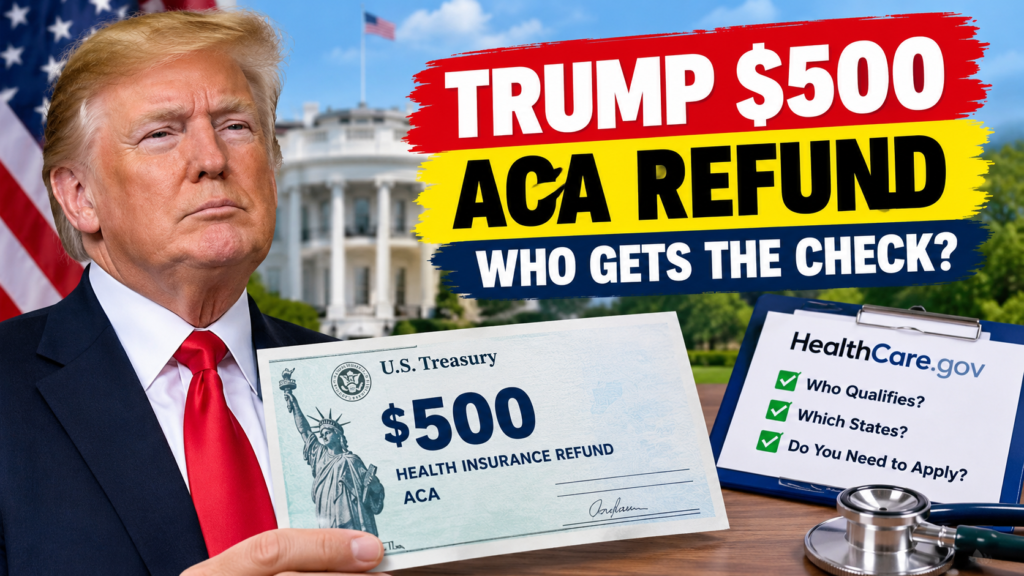
Trump $500 ACA Refund: The Trump administration has started sending $500 ACA refund checks to nearly 1 million Americans who purchased health insurance through the Affordable Care Act marketplace.
The first payments began going out on September 30, 2026. The refunds are being sent to eligible people in 30 states that use the federal HealthCare.gov marketplace.
The White House says the payments are meant to return excess money collected through ACA marketplace user fees. However, the administration’s explanation of how those fees were collected and who was ultimately affected has drawn debate among health policy experts.
Here is what you need to know about the Trump $500 ACA refund, including who may qualify, which states are included, and whether you need to apply.
White House Refund Announcement
Why Is the Government Sending $500 ACA Refund Checks?
The refunds are connected to fees charged to insurance companies that sell health plans through HealthCare.gov.
These fees are known as ACA marketplace user fees. They help pay for the operation of the federal insurance marketplace.
The Trump administration says the federal government collected more in user fees than was needed to operate the exchange. It argues that those costs were ultimately reflected in insurance premiums paid by consumers.
The White House has described the excess money as an overcharge and says it should be returned to Americans who paid the full cost of their ACA coverage.
However, that explanation is disputed.
Health policy experts have pointed out that the surplus was not necessarily created only during the Biden administration. Some of the money may have come from user fees collected during earlier years, including during Trump’s first administration.
KFF health policy analyst Cynthia Cox told the Associated Press that the federal marketplace had accumulated unspent user-fee money before Biden left office. That makes the administration’s description of the refunds as money collected specifically because of Biden-era mismanagement more complicated.
So, while the refunds are real, the political explanation surrounding the money remains contested.
Who Can Receive the $500 ACA Refund?
The program is much narrower than the phrase “$500 health insurance refund” might suggest.
According to the White House, the payments are aimed primarily at people who purchased 2026 ACA coverage through HealthCare.gov without receiving premium assistance.
That means many ACA customers will not receive a payment.
In general, potential recipients must meet the following conditions:
- They enrolled in an ACA health plan through HealthCare.gov.
- They live in one of the 30 states using the federal marketplace.
- They paid the full premium without receiving a federal premium subsidy.
- Their coverage falls within the group identified by the federal government for the refund program.
Most eligible recipients are people who paid the full cost of their marketplace insurance.
People who received premium tax credits generally are not included because the administration says the refund is intended for people who paid the full premium themselves.
Is the Payment $500 Per Person or Per Household?
This is an important detail.
The payment is $500 per eligible person, not simply one $500 payment for every household.
Therefore, a household with more than one qualifying enrollee could receive multiple payments if each person meets the eligibility requirements.
The White House said nearly 1 million Americans would receive the refund. Recent reports put the number at more than 950,000 people.
Which States Are Included?
The refund program applies to the 30 states that use the federal HealthCare.gov marketplace for their ACA plans.
The states listed by the White House are:
Alabama, Alaska, Arizona, Arkansas, Delaware, Florida, Hawaii, Indiana, Iowa, Kansas, Louisiana, Michigan, Mississippi, Missouri, Montana, Nebraska, New Hampshire, North Carolina, North Dakota, Ohio, Oklahoma, Oregon, South Carolina, South Dakota, Tennessee, Texas, Utah, West Virginia, Wisconsin and Wyoming.
If you live in a state that operates its own ACA marketplace, you are not included in this particular federal refund program.
For example, California and New York operate their own state-based marketplaces.
Do You Need to Apply for the Refund?
No separate application is expected for eligible recipients.
The administration says it has already identified the people who qualify using existing government records.
That means you should be cautious if you receive an unexpected message asking you to provide your Social Security number, bank details, credit card information or other sensitive information to “claim” the $500 refund.
A legitimate government payment should not require you to pay a fee to receive the money.
Scammers may try to use the refund announcement to send fake emails, text messages or websites. If you receive a suspicious message, verify the information through an official government source before sharing personal details.
When Are the $500 Checks Being Sent?
The Trump administration originally announced that the payments would begin in October 2026.
The government then began sending the refunds on September 30, 2026, according to the administration and multiple news reports.
The payments are being distributed through the U.S. Treasury Department. Recipients are also receiving a letter from President Donald Trump explaining the administration’s position on the refunds.
Because the payments are being sent to a large number of people, recipients may not all receive their money on the same day.
Why Is the Refund Program Controversial?
The basic idea of returning unused government funds sounds simple. The debate is mainly about where the money came from and how the payments should be described.
The Trump administration says Americans were effectively overcharged because marketplace user fees were higher than necessary. It argues that the excess money should be returned to the people who paid the premiums.
Some health policy experts have questioned that interpretation.
One major issue is the timing of the money. Analysts have pointed out that the federal marketplace had accumulated surplus user-fee funds across multiple administrations.
That means it is difficult to attribute the entire surplus to one administration.
There is also debate over whether the $500 payment represents the exact amount any individual consumer was overcharged. The available information does not establish that every recipient personally paid exactly $500 in excess fees.
For that reason, it is more accurate to describe the payment as a one-time federal refund based on surplus marketplace user fees, while noting that the administration describes those fees as overcharges.
How Is This Different From a Normal ACA Insurance Rebate?
The $500 payment should not be confused with the regular Affordable Care Act Medical Loss Ratio (MLR) rebates.
MLR rebates are payments that some insurance companies must send to policyholders when they fail to spend a required share of premium dollars on medical care and quality improvement.
The new $500 federal payment is different.
It comes from the federal government’s handling of marketplace user fees and is being distributed through the Treasury Department.
So, receiving or not receiving an MLR rebate does not automatically determine whether someone qualifies for the new $500 ACA refund.
Why Does the Refund Matter?
The payments come at a time when the cost of health insurance has become a major concern for many Americans.
ACA marketplace customers have faced changes in premiums and financial assistance. Enhanced federal premium tax credits that had been available in previous years expired at the end of 2025, increasing costs for some people who remained enrolled without the same level of assistance.
That makes the $500 payment significant for the people who qualify, even though it is a one-time payment.
At the same time, the refund does not automatically reduce the monthly premium of an ACA plan. It is a separate payment to eligible recipients.
For consumers, that distinction is important when calculating their overall healthcare costs.
What Should ACA Enrollees Do Now?
If you purchased ACA insurance through HealthCare.gov in 2026, you can check whether you meet the basic conditions for the refund.
Start by confirming:
- You purchased your plan through HealthCare.gov.
- You live in one of the 30 participating states.
- You paid the full premium without premium assistance.
- Your information with the marketplace is current.
Eligible people do not need to submit a new application for the refund, according to the administration.
If you receive a message asking for payment or sensitive financial information in exchange for the refund, treat it as suspicious.
The Bottom Line
The Trump $500 ACA refund checks are now being distributed to nearly 1 million eligible Americans across 30 states.
The payment is generally $500 per eligible person, rather than a flat $500 payment per household.
The program mainly targets ACA enrollees who bought 2026 coverage through HealthCare.gov and paid the full premium without federal premium assistance.
The Trump administration says the money comes from surplus marketplace user fees that were effectively passed on to consumers. However, health policy experts have questioned whether the surplus can be attributed solely to the Biden administration and whether it is accurate to describe the entire amount as a direct overcharge.
For eligible recipients, the payment is real. The broader debate is about how the surplus was created and how the government should characterize the money being returned.
As the checks continue to arrive, ACA enrollees should rely on official government information and remain alert for scams using the $500 refund as a reason to request personal or financial information.
Also Read This
- Nothing Headphone (1) Pro Review: Is This Premium Over-Ear Headphone Worth It?
- Nothing Headphone (1) Pro V: BTS Star Becomes Global Brand Ambassador
- Spotify Outage: Thousands of Users Report Problems With Music Streaming Service
- Renault’s Hybrid Blitz: 3 New SUVs Coming by 2027, Here’s What We Know
- AI and Molecular Simulation: Can AI Make Chemistry Thousands of Times Faster?